>
Acanthuriformes (Surgeonfishes) >
Siganidae (Rabbitfishes)
Etymology: Siganus: Latin, siganus = a fish, rabbit fish; by the similarity of the nose (Ref. 45335).
More on author: Rüppell.
Environnement : milieu / zone climatique / profondeur / gamme de distribution
Écologie
marin récifal; profondeur 2 - 40 m (Ref. 12382). Subtropical; 35°N - 35°S
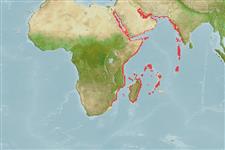
Western Indian Ocean: Persian Gulf (Ref.80050); Red Sea and East Africa to islands in the western Indian Ocean. Immigrant to Mediterranean via the Suez Canal.
Longueur à la première maturité / Taille / Poids / Âge
Maturité: Lm 14.2 range ? - ? cm
Max length : 30.0 cm TL mâle / non sexé; (Ref. 30573); common length : 20.0 cm TL mâle / non sexé; (Ref. 30573)
Description synthétique
Clés d'identification | Morphologie | Morphométrie
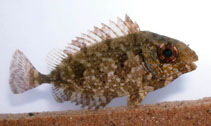
Épines dorsales (Total) : 13 - 14; Rayons mous dorsaux (Total) : 10; Épines anales: 7; Rayons mous anaux: 9; Vertèbres: 13. Regional variation in color exists. Anterior spines of median fins slender and pungent, posterior spines stout, all venomous including that on the nape. Preopercular angle 87-97 degrees. Anterior nostril with a long, broad flap covering posterior nostril when depressed. Variable cheek scalation. Midline of thorax devoid of scales between the pelvic ridges.
Body shape (shape guide): fusiform / normal; Cross section: compressed.
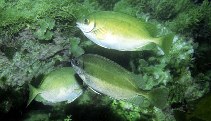
Found in small schools in very shallow water close to the bottom. Prefer hard bottoms of compacted sand with rock or coral debris. Solitary adults and groups of 3 or 4 adults have also been observed. Feed on a wide range of benthic algae. May suddenly stop and erect its fins (dorsal, anal and pelvic) presenting an encircling array of spines to potential predators; these spines are venomous. A food fish that is occasionally poisonous (Ref. 4537). Probably does not adapt well in captivity (Ref. 12382). A thermophilic species (Ref. 120766). Minimum depth from Ref. 9710.
The larvae maintain themselves near the water surface (Ref. 1419). Feeding on phytoplankton and zooplankton begins 3 days after hatching (Ref. 1419).
Woodland, D.J., 1990. Revision of the fish family Siganidae with descriptions of two new species and comments on distribution and biology. Indo-Pac. Fish. (19):136 p. (Ref. 1419)
Statut dans la liste rouge de l'IUCN (Ref. 130435: Version 2025-2 (Global))
Utilisations par l'homme
Pêcheries: intérêt commercial mineur
Outils
Articles particuliers
Télécharger en XML
Sources Internet
Estimations basées sur des modèles
Température préférée (Réf.
123201): 24.8 - 29.2, mean 27 °C (based on 294 cells).
Indice de diversité phylogénétique (Réf.
82804): PD
50 = 0.5000 [Uniqueness, from 0.5 = low to 2.0 = high].
Bayesian length-weight: a=0.01259 (0.01009 - 0.01571), b=2.99 (2.94 - 3.04), in cm total length, based on LWR estimates for this species (Ref.
93245).
Niveau trophique (Réf.
69278): 2.0 ±0.0 se; based on diet studies.
Generation time: 5.2 ( na - na) years. Estimated as median ln(3)/K based on 1
growth studies.
Résilience (Réf.
120179): Milieu, temps minimum de doublement de population : 1,4 à 4,4 années (K=0.3).
Vulnérabilité de la pêche (Ref.
59153): Moderate vulnerability (39 of 100).
🛈
Nutriments (Ref.
124155): Calcium = 20.3 [9.9, 51.9] mg/100g; Iron = 0.568 [0.259, 1.296] mg/100g; Protein = 19.3 [18.1, 20.4] %; Omega3 = 0.196 [0.099, 0.397] g/100g; Selenium = 8.35 [3.05, 21.97] μg/100g; VitaminA = 51.8 [13.7, 186.8] μg/100g; Zinc = 1.16 [0.45, 2.44] mg/100g (wet weight);