Environnement : milieu / zone climatique / profondeur / gamme de distribution
Écologie
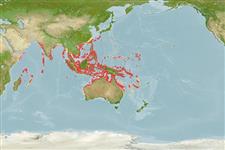
marin récifal; profondeur 3 - 30 m (Ref. 48637), usually 5 - 30 m (Ref. 27115). Tropical; 24°C - 27°C (Ref. 27115); 30°N - 30°S, 49°E - 170°E
Indo-West Pacific: Aldabra Islands, Seychelles, Maldives, Andaman Sea, Thailand, Indonesia, Peninsular Malaysia, Sabah, Singapore, Viet Nam, Philippines, Ryukyu Islands, Ogasawara Islands, Palau, ?Kiribati, Papua New Guinea, Solomon Islands, Australia, Vanuatu, and New Caledonia. Replaced by Siganus trispilos in northwest Australia (Ref. 37816).
Taille / Poids / Âge
Maturité: Lm ? range ? - ? cm
Max length : 35.0 cm SL mâle / non sexé; (Ref. 48637); common length : 20.0 cm TL mâle / non sexé; (Ref. 9813)
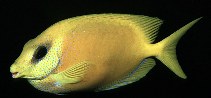
Épines dorsales (Total) : 13; Rayons mous dorsaux (Total) : 10; Épines anales: 7; Rayons mous anaux: 9; Vertèbres: 13. Head, body and fins orange-yellow; pale blue ocelli with darker blue margins on head, thorax and sides; spots about pinhead size, larger and more crowded on head, sometimes smaller on sides; ocelli may extend onto bases of dorsal and anal fins, and on bases of outer rays of caudal fin. Very small juveniles (up to 50 mm SL) may have vertical blue lines on side, fragmenting into the ocelli with increase in size. Orbit with a diffused-edged dark, triangular smudge; orange-brown iris Fin spines stout, pungent and venomous. Midline of thorax and ridges fully scaled.
Body shape (shape guide): short and / or deep; Cross section: compressed.
Occurs in coral-rich areas of lagoons. Juveniles found in small schools in shallow seagrass beds and reefs; often found among Acropora corals. Adults usually in pairs on shallow coral reefs and feed on benthic algae. A food fish that is occasionally poisonous (Ref. 4537, 48637).
Cycle de vie et comportement reproducteur
Maturité | Reproduction | Frai | Œufs | Fécondité | Larves
Woodland, D.J., 1990. Revision of the fish family Siganidae with descriptions of two new species and comments on distribution and biology. Indo-Pac. Fish. (19):136 p. (Ref. 1419)
Statut dans la liste rouge de l'IUCN (Ref. 130435: Version 2025-2 (Global))
Utilisations par l'homme
Pêcheries: commercial; Aquarium: Commercial
Outils
Articles particuliers
Télécharger en XML
Sources Internet
Estimations basées sur des modèles
Température préférée (Réf.
123201): 24.7 - 29, mean 28.1 °C (based on 1288 cells).
Indice de diversité phylogénétique (Réf.
82804): PD
50 = 0.5000 [Uniqueness, from 0.5 = low to 2.0 = high].
Bayesian length-weight: a=0.01175 (0.00712 - 0.01939), b=3.10 (2.96 - 3.24), in cm total length, based on LWR estimates for this species & Genus-body shape (Ref.
93245).
Niveau trophique (Réf.
69278): 2.0 ±0.0 se; based on diet studies.
Résilience (Réf.
120179): Haut, temps minimum de doublement de population inférieur à 15 mois (Preliminary K or Fecundity.).
Vulnérabilité de la pêche (Ref.
59153): Low to moderate vulnerability (33 of 100).
🛈
Nutriments (Ref.
124155): Calcium = 34.9 [17.2, 80.0] mg/100g; Iron = 0.648 [0.306, 1.487] mg/100g; Protein = 18.5 [17.0, 20.0] %; Omega3 = 0.1 [0.1, 0.2] g/100g; Selenium = 21.7 [8.7, 54.3] μg/100g; VitaminA = 32.8 [7.7, 133.2] μg/100g; Zinc = 1.33 [0.52, 2.82] mg/100g (wet weight);