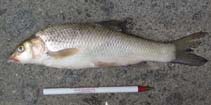
Classificazione / Nomi
Nomi Comuni | Sinonimi | Catalog of Fishes(Genere, Specie) | ITIS | CoL | WoRMS | Cloffa
>
Cypriniformes (Carps) >
Cyprinidae (Minnows or carps) > Barbinae
Eponymy: Professor Dr Mariano de la Paz Graëlls y de la Aguera (1809–1898) of Madrid was a botanist, entomologist and malacologist. [...] (Ref. 128868), visit book page.
More on author: Steindachner.
Ambiente: milieu / zona climatica / distribuzione batimetrica / gamma di distribuzione
Ecologia
; acqua dolce benthopelagico; potamodromo (Ref. 138297).
Deprecated: strtoupper(): Passing null to parameter #1 ($string) of type string is deprecated in /var/www/html/includes/speciessummary.lib.php on line 1612
Temperate; 44°N - 41°N, 5°W - 0°
Europe: Spain from Ebro to Ter drainages on Mediterranean slope and westward to Ason drainage on Atlantic slope. Introduced to central Italy in Fiora, Ombrone and Albegna drainages.
Lunghezza alla prima maturità / Dimensione / Peso / Età
Maturità: Lm 17.5, range 15 - 20 cm
Max length : 80.0 cm TL maschio/sesso non determinato; (Ref. 27345); Età massima riportata: 16 anni (Ref. 59043)
Breve descrizione
Chiavi di identificazione | Morfologia | Morfometria
Diagnosed from other species of Barbus and Luciobarbus in Iberian Peninsula by having the following characters: lateral line with 43-48 + 2-3 scales; last simple dorsal ray slender, not serrated posteriorly in adults, occasionally with a few small, widely set serrae in individuals smaller than about 15 cm SL; posterior barbel reaching beyond posterior margin of eye; lower lip thick, without median lobe; and lower jaw tip covered by lower lip (Ref. 59043).
Body shape (shape guide): elongated.
Adults inhabit lower and middle reaches of rivers with slow current, preferring areas with vegetation and shore cover. They migrate upstream areas with faster current and gravel or stone bottom for spawning (Ref. 59043). They feed on invertebrates and plants (Ref. 26100) and algae (Ref. 59043).
Ciclo vitale e comportamento di accoppiamento
Maturità | Riproduzione | Deposizione | Uova | Fecondità | Larve
Kottelat, M. and J. Freyhof, 2007. Handbook of European freshwater fishes. Publications Kottelat, Cornol and Freyhof, Berlin. 646 pp. (Ref. 59043)
Stato della Lista Rossa IUCN (Ref. 130435: Version 2025-2 (Global))
Minaccia per l'uomo
Harmless
Usi umani
Pesce da pesca sportiva: si
Strumenti
Rapporti speciali
Scarica XML
Fonti Internet
Stime basate su modelli
Indice di diversità filogenetica (Fonte Biblio.
82804): PD
50 = 0.5000 [Uniqueness, from 0.5 = low to 2.0 = high].
Bayesian length-weight: a=0.00794 (0.00655 - 0.00963), b=3.09 (3.04 - 3.14), in cm total length, based on LWR estimates for this species (Ref.
93245).
Livello trofico (Fonte Biblio.
69278): 2.8 ±0.29 se; based on food items.
Generation time: 5.9 ( na - na) years. Estimated as median ln(3)/K based on 1
growth studies.
Resilienza (Fonte Biblio.
120179): Medio, tempo minimo di raddoppiamento della popolazione 1.4 - 4.4 anni (Preliminary K or Fecundity.).
Vulnerabilità della pesca (Ref.
59153): Moderate to high vulnerability (52 of 100).
🛈