>
Ophidiiformes (Cusk eels) >
Dinematichthyidae (Viviparous brotula)
Etymology: Ogilbia: Taken from Ogilby, 1887-1915, icthiologist and zoologist (Ref. 45335).
Eponymy: James Douglas Ogilby (1853–1925) was an Irish-born Australian ichthyologist and taxonomist, son of the famous zoologist William Ogilby (below). [...] André de Roy moved (1955) with his wife Jacqueline, daughter Tui and son Gil to Academy Bay, Santa Cruz Island, Galápagos Islands, which is where he helped collect the holotype. [...] (Ref. 128868), visit book page.
More on authors: Poll & vanMol.
Ambiente: milieu / zona climatica / distribuzione batimetrica / gamma di distribuzione
Ecologia
marino associati a barriera corallina; distribuzione batimetrica 0 - 10 m (Ref. 57883). Tropical
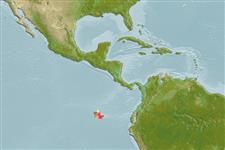
Southeast Pacific: Galapagos Islands.
Dimensione / Peso / Età
Maturità: Lm ? range ? - ? cm
Max length : 7.0 cm TL maschio/sesso non determinato; (Ref. 11482)
Breve descrizione
Chiavi di identificazione | Morfologia | Morfometria
Raggi dorsali molli (totale) : 68 - 80; Raggi anali molli: 51 - 59; Vertebre: 39 - 43. This species is characterized by the following: vertebrae 11-12 + 27-31 = 39-43, dorsal fin rays 68-80, anal fin rays 51-59; outer pseudoclasper with a broad base and long supporter with sharp, pointed tip; inner pseudoclasper is anteriorly inclined, of about length of outer pseudoclasper, with sharp, spine-like tip anteriorly and fleshy flap posteriorly; isthmus between pseudoclaspers wide, penis with abrupt change in thickness; opercular spine with a single, sharp tip; cheeks naked or with few isolated scales (less than 10 scales all together); otolith length: height ratio 2.1-2.2; upper preopercular pore absent (Ref. 57883).
Body shape (shape guide): elongated.
Inhabits rocky crevices (Ref. 11482). Two paratypes that were collected at low tide between blocks of lava in about 50 cm of water, were observed to move slowly close to the sand bottom. Experiments that were carried out showed that O. deroyi can tolerate a wide
variation in salinity, but not the low salinity in which O. galapagosensis lives. Consequently, there is an ecological barrier separating the two species. Only about five embryos were observed in ripe females (Ref. 57883).
Ciclo vitale e comportamento di accoppiamento
Maturità | Riproduzione | Deposizione | Uova | Fecondità | Larve
Møller, P.R., W. Schwarzhans and J.G. Nielsen, 2005. Review of the American Dinematichthyini (Teleostei: Bythitidae). Part II. Ogilbia. aqua, J. Ichthyol. Aquat. Biol. 10(4):133-207. (Ref. 57883)
Stato della Lista Rossa IUCN (Ref. 130435: Version 2025-2 (Global))
Minaccia per l'uomo
Harmless
Usi umani
Pesca: di nessun interesse
Strumenti
Rapporti speciali
Scarica XML
Fonti Internet
Stime basate su modelli
Temperatura preferita (Fonte Biblio.
123201): 23.6 - 24.6, mean 23.9 °C (based on 12 cells).
Indice di diversità filogenetica (Fonte Biblio.
82804): PD
50 = 0.5000 [Uniqueness, from 0.5 = low to 2.0 = high].
Bayesian length-weight: a=0.00389 (0.00180 - 0.00842), b=3.12 (2.94 - 3.30), in cm total length, based on all LWR estimates for this body shape (Ref.
93245).
Livello trofico (Fonte Biblio.
69278): 3.3 ±0.5 se; based on size and trophs of closest relatives
Resilienza (Fonte Biblio.
120179): Basso, tempo minimo di raddoppiamento della popolazione 4.5 - 14 anni (Assuming Fec < 100).
Vulnerabilità della pesca (Ref.
59153): Low vulnerability (10 of 100).
🛈