>
Dactylopteriformes (Flying gurnards) >
Pegasidae (Seamoths)
Etymology: Eurypegasus: Greek, eurys = long + Greek, Pegasus, pege = springs of Ocean near which Medusa was said to have been killed; the winged horse, sprung from the blood of Medusa (Ref. 45335); draconis: From the Latin word 'draco' meaning fabulous, lizard-like animal.
More on author: Linnaeus.
Umwelt: Milieu / Klimazone / Tiefenbereich / Verbreitungsgebiet
Ökologie
seewasser; brackwasser demersal; standorttreu (Ref. 52884); tiefenbereich 3 - 91 m (Ref. 26165), usually 35 - 90 m (Ref. 33989). Tropical; 32°N - 32°S
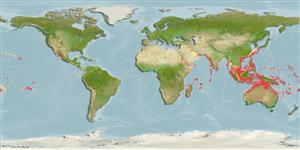
Indo-Pacific: Red Sea and South Africa (Ref. 4264) to Marquesan and Society Islands, north to southern Japan, south to Australia and Lord Howe Island; throughout Micronesia.
Größe / Gewicht / Alter
Geschlechtsreife: Lm ? range ? - ? cm
Max length : 10.0 cm TL Männchen/unbestimmt; (Ref. 3132)
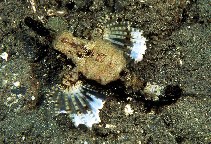
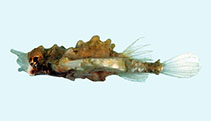
Rückenflossenstacheln (insgesamt) : 0; Rückenflossenweichstrahlen (insgesamt) : 5; Afterflossenstacheln: 0; Afterflossenweichstrahlen: 5; Wirbelzahl: 19 - 22. Color in life variable; body usually light to dark brown, with dorsal and lateral area darker than ventral surface. Pectoral fins hyaline, distal margin white and spotted. Pelvic fin spine and 1st ray forming an elongate, tentacular structure. 3 pairs of dorsolateral body plates; 4 pairs of ventrolateral body plates; tail rings 8 (rarely 9), mobile. A pair of deep pits posterior to orbit. Suborbital shelf concave, eye visible in ventral view. Ventral ridges of rostrum greatly expanded than dorsal ridges, each with laterally directed denticles. Anal papilla absent.
Body shape (shape guide): other; Cross section: flattened.
Inhabit lagoons often among algal or seagrass beds (Ref. 5503). Found on sand or silt bottoms, frequently in bays or estuaries (Ref. 3132). They are opportunistic feeders that collect mainly epifaunal and interstitial invertebrate prey, e.g., crustaceans and worms from the sediment-water interface (Ref. 31134). Shed their skin in one piece with a rapid jump periodically to rid themselves of accumulated ballast (Ref. 31134). Adults usually in pairs on muddy substrates (Ref. 48635). They exhibit a monogamous mating system with close-pair bonding (Ref. 90102). Pairs are home-ranging that is they do not defend an exclusive territory (Ref. 52884).
Lebenszyklus und Paarungsverhalten
Geschlechtsreife | Fortpflanzung | Ablaichen | Eier | Fruchtbarkeit | Larven
Are broadcast spawners. In several aquaria, spawning is observed as pairs rose to about 50 cm above the substrate, their ventral surfaces closely opposed, releasing gametes at the apex of their upward rush; then they glided down to the bottom. As the pairs landed on the substrate, the male continued to follow his mate. Release of gametes follows. Spawning occurred only within pairs (obligate and genetic monogamy) (Ref. 52884).
Palsson, W.A. and T.W. Pietsch, 1989. Revision of the Acanthopterygian fish Family Pegasidae (Order Gasterosteiformes). Indo-Pac. Fish. (18):38 p. (Ref. 1418)
IUCN Rote Liste Status (Ref. 130435: Version 2025-2 (Global))
Bedrohung für Menschen
Harmless
Nutzung durch Menschen
Tools
Zusatzinformationen
Download XML
Internet Quellen
Schätzungen auf der Grundlage von Modellen
Bevorzugte Temperatur (Ref.
123201): 21.8 - 28.3, mean 26.7 °C (based on 757 cells).
Phylogenetischer Diversitätsindex (Ref.
82804): PD
50 = 0.7579 [Uniqueness, from 0.5 = low to 2.0 = high].
Bayesian length-weight: a=0.01000 (0.00244 - 0.04107), b=3.04 (2.81 - 3.27), in cm total length, based on all LWR estimates for this body shape (Ref.
93245).
Trophische Ebene (Ref.
69278): 3.2 ±0.36 se; based on food items.
Anfälligkeit der Fischerei (Ref.
59153): Low vulnerability (10 of 100).
🛈
Nährstoffe (Ref.
124155): Calcium = 145 [80, 343] mg/100g; Iron = 1.25 [0.67, 2.19] mg/100g; Protein = 18.4 [17.1, 19.6] %; Omega3 = 0.218 [0.102, 0.474] g/100g; Selenium = 48.1 [20.1, 106.8] μg/100g; VitaminA = 61 [17, 206] μg/100g; Zinc = 2.95 [1.88, 4.31] mg/100g (wet weight);