>
Eupercaria/misc (Various families in series Eupercaria) >
Nemipteridae (Threadfin breams, Whiptail breams)
Etymology: Nemipterus: Greek, nema, -atos = filament + Greek, pteron = wing, fin (Ref. 45335).
More on author: Bleeker.
Umwelt: Milieu / Klimazone / Tiefenbereich / Verbreitungsgebiet
Ökologie
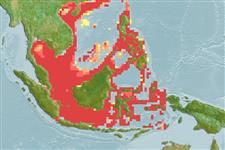
seewasser demersal; standorttreu. Tropical; 22°N - 9°S, 96°E - 131°E (Ref. 3810)
Western Central Pacific: including the Philippines, Gulf of Thailand, South China Sea, Strait of Malacca and Indonesia.
Größe / Gewicht / Alter
Geschlechtsreife: Lm ? range ? - ? cm
Max length : 21.0 cm SL Männchen/unbestimmt; (Ref. 3810); common length : 17.0 cm SL Männchen/unbestimmt; (Ref. 3810)
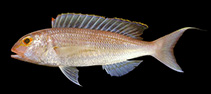
Rückenflossenstacheln (insgesamt) : 10; Rückenflossenweichstrahlen (insgesamt) : 9; Afterflossenstacheln: 3; Afterflossenweichstrahlen: 7. Suborbital spine absent. Preopercle with three transverse scale rows. Pectoral and pelvic fins moderately long, reaching to or just short of level of anus. A line drawn up from posterior edge of suborbital reaching the dorsal profile at about 3 to 7 scale rows before origin of dorsal fin. Upper lobe of caudal fin produced into a trailing yellow filament. Axillary scale present. Color: Upper body pinkish, pearly white below. Membrane of first 2 dorsal spines bright red superiorly. Golden yellow stripe from posterior nostril through eye and from upper lip to lower eye.
Body shape (shape guide): fusiform / normal; Cross section: oval.
Inhabits muddy or sandy bottoms. Feeds on small fishes and larger benthic invertebrates. Most abundant species of Nemipterus in bottom trawl catches from the South China Sea.
Lebenszyklus und Paarungsverhalten
Geschlechtsreife | Fortpflanzung | Ablaichen | Eier | Fruchtbarkeit | Larven
Russell, B.C., 1990. FAO Species Catalogue. Vol. 12. Nemipterid fishes of the world. (Threadfin breams, whiptail breams, monocle breams, dwarf monocle breams, and coral breams). Family Nemipteridae. An annotated and illustrated catalogue of nemipterid species known to date. FAO Fish. Synop. 125(12):149p. Rome: FAO. (Ref. 3810)
IUCN Rote Liste Status (Ref. 130435: Version 2025-2 (Global))
Bedrohung für Menschen
Harmless
Nutzung durch Menschen
Fischereien: weniger kommerziell
Tools
Zusatzinformationen
Download XML
Internet Quellen
Schätzungen auf der Grundlage von Modellen
Bevorzugte Temperatur (Ref.
123201): 22.5 - 28.6, mean 27.6 °C (based on 489 cells).
Phylogenetischer Diversitätsindex (Ref.
82804): PD
50 = 0.5000 [Uniqueness, from 0.5 = low to 2.0 = high].
Bayesian length-weight: a=0.01349 (0.00862 - 0.02112), b=2.96 (2.83 - 3.09), in cm total length, based on LWR estimates for this species & Genus-body shape (Ref.
93245).
Trophische Ebene (Ref.
69278): 4.0 ±0.66 se; based on food items.
Widerstandsfähigkeit (Ref.
120179): mittel, Verdopplung der Population dauert 1,4 - 4,4 Jahre. (K=0.28).
Anfälligkeit der Fischerei (Ref.
59153): Low to moderate vulnerability (26 of 100).
🛈