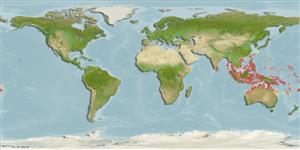
Ambiente: milieu / zona climatica / distribuzione batimetrica / gamma di distribuzione
Ecologia
marino; salmastro associati a barriera corallina; distribuzione batimetrica 0 - 20 m (Ref. 48637), usually 0 - 15 m (Ref. 90102). Tropical; 19°C - 38°C (Ref. 1827); 30°N - 30°S, 77°E - 20°W
Indo-West Pacific: India, Sri Lanka, Andaman Islands, Thailand, Malaysia, Singapore, Indonesia, Philippines, Belau [=Palau], Guam, New Guinea, Solomon Islands, Fiji, Vanuatu, ?New Caledonia, ?Western Australia, ?Pohnpei, Caroline Islands, ?Ebon Island and Marshall Islands.
Dimensione / Peso / Età
Maturità: Lm ? range ? - ? cm
Max length : 45.0 cm TL maschio/sesso non determinato; (Ref. 1419); common length : 30.0 cm TL maschio/sesso non determinato; (Ref. 9813); peso massimo pubblicato: 2.4 kg (Ref. 125599)
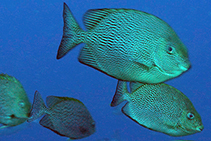
Spine dorsali (totale) : 13; Raggi dorsali molli (totale) : 10; Spine anali: 7; Raggi anali molli: 9; Vertebre: 13. Body bluish white; head brown to brownish or golden yellow with irregular blue lines. Preopercular angle 91°-102°; strong overlapping scales cover cheeks; midline of thorax scaled, not pelvic ridges. Anterior nostril with low flange, broadened slightly posteriorly. Spines stout, blunt or pungent, and venomous.
Body shape (shape guide): short and / or deep; Cross section: compressed.
Juveniles live among mangroves then move out to lagoon and coastal reefs as they mature. Forms schools. Feeds on algae growing on seagrasses, mangrove roots and rocks. Adults congregate inshore in groups of several hundreds to spawn in summer. Spawning is by pairs; sticky eggs laid on the bottom. Its very high quality flesh commands premium prices (Ref. 9813). Adults on coastal reefs, subject to strong currents (Ref. 48637). This species can tolerate very low salinities (2 ppt) and temperatures up to 38 C (Ref. 37816).
Ciclo vitale e comportamento di accoppiamento
Maturità | Riproduzione | Deposizione | Uova | Fecondità | Larve
Throughout summer, adults form inshore breeding groups of several hundred individuals on the 7th or 8th days of the lunar month; pairs break from these groups to spawn. The species has a high fecundity of 350,000/spawning season.
Woodland, D.J., 1990. Revision of the fish family Siganidae with descriptions of two new species and comments on distribution and biology. Indo-Pac. Fish. (19):136 p. (Ref. 1419)
Stato della Lista Rossa IUCN (Ref. 130435: Version 2025-2 (Global))
Usi umani
Pesca: commerciale; Acquacoltura: probabile utilizzo futuro; Acquario: Commerciale
Strumenti
Rapporti speciali
Scarica XML
Fonti Internet
Stime basate su modelli
Temperatura preferita (Fonte Biblio.
123201): 26.2 - 29.3, mean 28.6 °C (based on 2941 cells).
Indice di diversità filogenetica (Fonte Biblio.
82804): PD
50 = 0.5000 [Uniqueness, from 0.5 = low to 2.0 = high].
Bayesian length-weight: a=0.01230 (0.00672 - 0.02252), b=3.11 (2.96 - 3.26), in cm total length, based on LWR estimates for this species & Genus-body shape (Ref.
93245).
Livello trofico (Fonte Biblio.
69278): 2.0 ±0.00 se; based on food items.
Resilienza (Fonte Biblio.
120179): Medio, tempo minimo di raddoppiamento della popolazione 1.4 - 4.4 anni (K=0.3).
Vulnerabilità della pesca (Ref.
59153): Low vulnerability (20 of 100).
🛈
Nutrienti (Ref.
124155): Calcium = 44.8 [22.4, 129.2] mg/100g; Iron = 0.979 [0.445, 2.429] mg/100g; Protein = 19 [17, 21] %; Omega3 = 0.0994 [, ] g/100g; Selenium = 35.2 [11.4, 95.8] μg/100g; VitaminA = 10.3 [2.0, 55.5] μg/100g; Zinc = 1.82 [0.68, 4.15] mg/100g (wet weight);