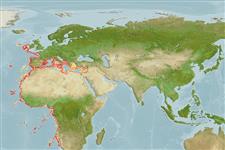
Umwelt: Milieu / Klimazone / Tiefenbereich / Verbreitungsgebiet
Ökologie
seewasser bathydemersal; standorttreu; tiefenbereich 395 - 1700 m (Ref. 3587). Deep-water; 55°N - 27°S, 26°W - 36°E
Eastern Atlantic: Irish slope to Cape Verde, including the Mediterranean. Occurrence in southern Africa is based only on specimens from off Namibia and not 'west coast of South Africa' as reported by Iwamoto 1986 (Ref. 2800 in FishBase) (Ref. 11953).
Größe / Gewicht / Alter
Geschlechtsreife: Lm ? range ? - ? cm
Max length : 60.0 cm TL Männchen/unbestimmt; (Ref. 11953); max. veröff. Alter: 11 Jahre (Ref. 58045)
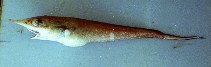
Snout long, narrow, sharply pointed. Dorsal scute row striating from just behind the head and extending to about behind a vertical through the anus, with more than 20 scute. Ventral scute row not reaching anus. Scute keels generally smooth blade-like, without multicuspid tips in small individuals (<30 cm), becoming more multicuspid with size. Scales adherent; belly completely scaled.
Body shape (shape guide): elongated.
Primarily a pelagic feeder, feeds primarily on pelagic copepods, but also takes mysids, shrimps, cephalopods, fish, polychaetes and gastropods (Ref. 1371). Mainly reduced to fishmeal and oil (Ref. 1371).
Lebenszyklus und Paarungsverhalten
Geschlechtsreife | Fortpflanzung | Ablaichen | Eier | Fruchtbarkeit | Larven
Cohen, D.M., T. Inada, T. Iwamoto and N. Scialabba, 1990. FAO species catalogue. Vol. 10. Gadiform fishes of the world (Order Gadiformes). An annotated and illustrated catalogue of cods, hakes, grenadiers and other gadiform fishes known to date. FAO Fish. Synop. 125(10). Rome: FAO. 442 p. (Ref. 1371)
IUCN Rote Liste Status (Ref. 130435: Version 2025-2 (Global))
Bedrohung für Menschen
Harmless
Nutzung durch Menschen
Fischereien: weniger kommerziell
Tools
Zusatzinformationen
Download XML
Internet Quellen
Schätzungen auf der Grundlage von Modellen
Bevorzugte Temperatur (Ref.
123201): 4.7 - 13.7, mean 10.4 °C (based on 141 cells).
Phylogenetischer Diversitätsindex (Ref.
82804): PD
50 = 0.5176 [Uniqueness, from 0.5 = low to 2.0 = high].
Bayesian length-weight: a=0.00309 (0.00117 - 0.00815), b=3.12 (2.89 - 3.35), in cm total length, based on LWR estimates for this (Sub)family-body shape (Ref.
93245).
Trophische Ebene (Ref.
69278): 3.6 ±0.3 se; based on diet studies.
Generation time: 3.7 ( na - na) years. Estimated as median ln(3)/K based on 2
growth studies.
Widerstandsfähigkeit (Ref.
120179): mittel, Verdopplung der Population dauert 1,4 - 4,4 Jahre. (K=0.22-0.35).
Anfälligkeit der Fischerei (Ref.
59153): Moderate vulnerability (38 of 100).
🛈
Klimaanfälligkeit (Ref.
125649): Low vulnerability (13 of 100).
🛈
Nährstoffe (Ref.
124155): Calcium = 23.5 [12.6, 51.5] mg/100g; Iron = 0.403 [0.201, 0.813] mg/100g; Protein = 16.7 [15.0, 18.4] %; Omega3 = 0.241 [0.109, 0.505] g/100g; Selenium = 26.3 [10.7, 61.6] μg/100g; VitaminA = 8.08 [1.67, 36.00] μg/100g; Zinc = 0.38 [0.25, 0.59] mg/100g (wet weight);