Ελασμοβράγχιοι (καρχαρίες και σαλάχια) (sharks and rays) >
Rajiformes (Skates and rays) >
Rajidae (Skates)
Etymology: Raja: Latin, raja, -ae = a sting ray (Raja sp.) (Ref. 45335).
Περιβάλλον: περιβάλλον / κλιματική ζώνη / εύρος βάθους / εύρος διανομής
Οικολογία
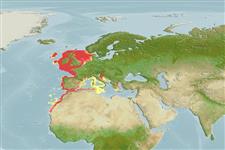
Θαλασσινό(ά) βενθικό(ς); εύρος βάθους 10 - 380 m (Ref. 6808). Temperate; 60°N - 22°N, 18°W - 24°E
Eastern Atlantic: Shetland Islands to Morocco, Rio de Oro (Western Sahara), and Madeira.
Μήκος κατά την πρώτη ωρίμανση / Μέγεθος / Βάρος / Ηλικία
Γεννητική Ωρίμανση: Lm 90.2, range 60 - ? cm
Max length : 120 cm TL αρσενικό/απροσδιόριστο; (Ref. 41333); 125.0 cm TL (female); μεγ. δημοσιευμένο βάρος: 14.3 kg (Ref. 40637)
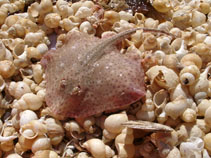
Ραχιαίες άκανθες (συνολικά) : 0; Εδρικές άκανθες: 0. Upper surface wholly prickly, except in juveniles; underside only prickly along front margins of disc; orbital thorns separate; a regular median row of 40-45 thorns in juveniles and adult females, interrupted on back in males; 60-90 tooth rows; upper surface ochre, with numerous small dark spots to margins of disc, underside white (Ref. 3167).
Body shape (shape guide): other; Cross section: flattened.
Found on sand and sand-rock bottoms (Ref. 6808). Feed on all kinds of benthic animals (Ref. 3167). Oviparous. Distinct pairing with embrace. Young may tend to follow large objects, such as their mother (Ref. 205). Eggs are oblong capsules with stiff pointed horns at the corners deposited in sandy or muddy flats (Ref. 205). Egg capsules are 10.0-14.3 cm long and 5.8-9.0 cm wide (Ref. 41250). About 40-90 eggs are laid per individual every year (Ref. 41250).
Oviparous, paired eggs are laid. Embryos feed solely on yolk (Ref. 50449). Spawning mainly from February to August with at least 30 egg-cases laid (Ref. 3167). Distinct pairing with embrace. Young may tend to follow large objects, such as their mother (Ref. 205).
McEachran, J.D. and K.A. Dunn, 1998. Phylogenetic analysis of skates, a morphologically conservative clade of elasmobranchs (Chondrichthyes: Rajidae). Copeia 1998(2):271-290. (Ref. 27314)
Κατάσταση Κόκκινου Καταλόγου IUCN (Ref. 130435: Version 2025-2 (Global))
Απειλή για τον άνθρωπο
Harmless
Ανθρώπινες χρήσεις
αλιεία: περιορισμένης εμπορικότητας; αλιεία αναψυχής: ναί
Εργαλεία
Ειδικές εκθέσεις
Λήψη XML
Διαδικτυακές πηγές
Εκτιμήσεις βάσει μοντέλων
Προτιμώμενη θερμοκρασία (Αναφ.
123201): 7.1 - 16.2, mean 10.3 °C (based on 462 cells).
Δείκτης φυλογενετικής ποικιλότητας (Αναφ.
82804): PD
50 = 0.5000 [Uniqueness, from 0.5 = low to 2.0 = high].
Bayesian length-weight: a=0.00229 (0.00147 - 0.00357), b=3.26 (3.14 - 3.38), in cm total length, based on LWR estimates for this species & Genus-body shape (Ref.
93245).
Τροφικό Επίπεδο (Αναφ.
69278): 3.8 ±0.61 se; based on food items.
Ελαστικότητα (Αναφ.
120179): Χαμηλό, ελάχιστος χρόνος για διπλασιασμό πληθυσμού 4,5 - 14 έτη (K=0.12-0.19; tmax=15; Fec=40).
Prior r = 0.20, 95% CL = 0.13 - 0.30, Based on 1 full stock assessment.
Ευπάθεια στην αλιεία (Ref.
59153): High to very high vulnerability (65 of 100).
🛈
Ευπάθεια στο κλίμα (Ref.
125649): High vulnerability (61 of 100).
🛈
Θρεπτικά συστατικά (Ref.
124155): Calcium = 4.69 [0.73, 84.95] mg/100g; Iron = 0.26 [0.02, 2.99] mg/100g; Protein = 16.7 [13.9, 19.0] %; Omega3 = 0.869 [0.349, 2.113] g/100g; Selenium = 14.8 [3.0, 71.4] μg/100g; VitaminA = 7.7 [0.6, 90.3] μg/100g; Zinc = 0.31 [0.02, 3.43] mg/100g (wet weight);