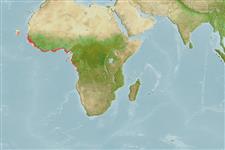
Ambiente: milieu / zona climatica / distribuzione batimetrica / gamma di distribuzione
Ecologia
marino; salmastro benthopelagico; distribuzione batimetrica 10 - 75 m (Ref. 27000), usually 20 - 50 m (Ref. 81287). Tropical; 30°N - 17°S, 27°W - 13°E
Eastern Atlantic: West African coast, from Senegal to Angola (Ref. 7350, 81287). Also reported from the Canary Islands, Cape Verde (Ref. 7350) and Mauritania (Ref. 5377).
Dimensione / Peso / Età
Maturità: Lm ? range ? - ? cm
Max length : 45.0 cm TL maschio/sesso non determinato; (Ref. 1380); common length : 30.0 cm TL maschio/sesso non determinato; (Ref. 3609); peso massimo pubblicato: 750.00 g (Ref. 4883)
Breve descrizione
Chiavi di identificazione | Morfologia | Morfometria
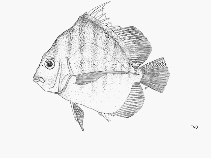
Spine dorsali (totale) : 8 - 9; Raggi dorsali molli (totale) : 17 - 18; Spine anali: 3; Raggi anali molli: 20 - 21. Diagnosis: body deep and strongly compressed, its anterior profile very steep up to dorsal-fin origin, and strongly compressed; head small; snout short; mouth small, terminal, strongly protrusible, with fleshy lips; teeth slender and pointed, set in bands in upper jaw; roof of mouth toothless; dorsal fin deeply notched; 1st dorsal fin spine small, forward-pointing and visible only in young individuals; pectorals falcate, very long, their tips almost reaching to caudal-fin base; hind margin of caudal fin slightly rounded; pelvic fins thoracic; scales finely ctenoid, covering body, bases of dorsal and anal fins and head, except snout and preopercle; preopercular margin denticulate; lateral line strongly arched (Ref. 81287).
Coloration: silvery grey, darker on back, almost white on belly; sides with a series of 8 brown, more or less faded vertical bars, always more distinct in young individuals (Ref. 81287).
Body shape (shape guide): short and / or deep; Cross section: compressed.
Neritic species (Ref. 7350). Essentially marine, often living in groups (Ref. 81287) over sandy and muddy bottoms (Ref. 2683), between 20 and 50 m depth, and entering coastal lagoons where sexual maturation begins (Ref. 81287). Feeds of fish eggs, benthic invertebrates and detritus (Ref. 28587).
Ciclo vitale e comportamento di accoppiamento
Maturità | Riproduzione | Deposizione | Uova | Fecondità | Larve
Desoutter, M., 1990. Ephippidae. p. 834-836. In J.C. Quero, J.C. Hureau, C. Karrer, A. Post and L. Saldanha (eds.) Check-list of the fishes of the eastern tropical Atlantic (CLOFETA). JNICT, Lisbon; SEI, Paris; and UNESCO, Paris. Vol. 2. (Ref. 7350)
Stato della Lista Rossa IUCN (Ref. 130435: Version 2025-2 (Global))
Minaccia per l'uomo
Harmless
Usi umani
Pesca: scarso interesse commerciale
Strumenti
Rapporti speciali
Scarica XML
Fonti Internet
Stime basate su modelli
Temperatura preferita (Fonte Biblio.
123201): 19.2 - 28, mean 26.1 °C (based on 132 cells).
Indice di diversità filogenetica (Fonte Biblio.
82804): PD
50 = 0.7500 [Uniqueness, from 0.5 = low to 2.0 = high].
Bayesian length-weight: a=0.01380 (0.00721 - 0.02644), b=2.98 (2.81 - 3.15), in cm total length, based on LWR estimates for this species & (Sub)family-body (Ref.
93245).
Livello trofico (Fonte Biblio.
69278): 3.1 ±0.41 se; based on food items.
Resilienza (Fonte Biblio.
120179): Basso, tempo minimo di raddoppiamento della popolazione 4.5 - 14 anni (K=0.13-0.25).
Vulnerabilità della pesca (Ref.
59153): High vulnerability (56 of 100).
🛈
Nutrienti (Ref.
124155): Calcium = 75.5 [41.3, 134.2] mg/100g; Iron = 0.711 [0.423, 1.229] mg/100g; Protein = 17.3 [16.3, 18.3] %; Omega3 = 0.169 [0.090, 0.319] g/100g; Selenium = 60.4 [29.3, 123.8] μg/100g; VitaminA = 21.9 [6.9, 66.7] μg/100g; Zinc = 1.43 [0.97, 2.10] mg/100g (wet weight);