Elasmobranquios (tiburones y rayas) (sharks and rays) >
Carcharhiniformes (Ground sharks) >
Proscylliidae (Finback catsharks)
Etymology: Eridacnis: Etymology not explained, possibly eri-, Greek intensive particle (i.e., very), and dakno (Gr.), bite, referring to “wide, angular” mouth of E. radcliffei (See ETYFish); barbouri: In honor of American herpetologist (and wealthy patron of science) Thomas Barbour (1884-1946), Director, Museum of Comparative Zoology, Harvard University, for the “constant assistance” he gave the authors in their studies of western North Atlantic sharks (See ETYFish).
Eponymy: Dr Thomas Barbour (1884–1946) was an American zoologist. [...] (Ref. 128868), visit book page.
Entorno: milieu / zona climática / rango de profundidad / gama de distribución
Ecología
marino batidemersal; rango de profundidad 400 - 650 m (Ref. 55584). Deep-water
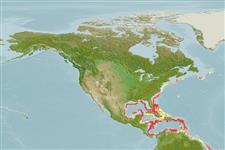
Western Central Atlantic: apparently confined to a limited area in the Florida Straits and off the north coast of Cuba.
Tamaño / Peso / Edad
Madurez: Lm ? range ? - ? cm
Max length : 200 cm TL macho / no sexado; (Ref. 26340); common length : 30.0 cm TL macho / no sexado; (Ref. 6077)
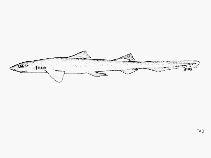
Found on the upper continental and insular slopes. Probably feeds on small fishes, crustaceans and cephalopods. Ovoviviparous, with two young in a litter. Size at birth over 10 cm.
Ciclo vital y comportamiento de apareamiento
Madurez | Reproducción | Puesta | Huevos | Fecundidad | Larva
Live-bearing, yolk-only (Ref. 50449).
Compagno, L.J.V., 1984. FAO Species Catalogue. Vol. 4. Sharks of the world. An annotated and illustrated catalogue of shark species known to date. Part 2 - Carcharhiniformes. FAO Fish. Synop. 125(4/2):251-655. Rome: FAO. (Ref. 244)
Situación en la Lista Roja de la UICN (Ref. 130435: Version 2025-2 (Global))
Amenaza para el ser humano
Harmless
Usos humanos
Pesquerías: sin interés
Herramientas
Informes especiales
Descargar XML
Fuentes de Internet
Estimaciones basadas en modelos
Temperatura preferida (Referencia
123201): 8.3 - 14.6, mean 10.6 °C (based on 47 cells).
Índice de diversidad filogenética (Referencia
82804): PD
50 = 0.6328 [Uniqueness, from 0.5 = low to 2.0 = high].
Bayesian length-weight: a=0.00288 (0.00112 - 0.00741), b=3.14 (2.91 - 3.37), in cm total length, based on LWR estimates for this (Sub)family-body shape (Ref.
93245).
Nivel trófico (Referencia
69278): 3.8 ±0.60 se; based on food items.
Resiliencia (Referencia
120179): Muy bajo, población duplicada en un tiempo mínimo superior a 14 años (Fec=2).
Vulnerabilidad pesquera (Ref.
59153): Very high vulnerability (90 of 100).
🛈