>
Cyprinodontiformes (Rivulines, killifishes and live bearers) >
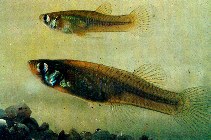
Poeciliidae (Poeciliids) > Poeciliinae
Etymology: Gambusia: Gambusia: From the Cuban term, Gambusino, which means "nothing", usually in the context of a joke or a farce. Fishing for gambusinos = when one catches nothing (Ref. 45335).
Eponymy: Dr John Edwards Holbrook (1794–1871) was a zoologist and herpetologist who has been described as ‘the Father of North American Herpetology’. [...] (Ref. 128868), visit book page.
More on author: Girard.
Miljö: miljö / Klimatzon / djupintervall / distributionsområde
Ekologi
; sötvatten; brackvatten bentopelagisk; pH range: 6.0 - 8.8; dH range: ? - 40; flodvandrande (Ref. 51243). Subtropical; 15°C - 35°C (Ref. 13371); 40°N - 31°N, 89°W - 74°W
Introduced worldwide in tropical and subtropical countries. North America: Atlantic and Gulf Slope drainages from New Jersey south to Alabama in USA (Ref. 5723). Established throughout southern Europe (Ref. 59043). Introduced for mosquito control, but had rare to non-existing effects on mosquitoes, and negative to perhaps neutral impact on native fishes (Ref. 12217).
Storlek / Vikt / Ålder
Könsmognad: Lm ? range ? - ? cm
Max length : 4.7 cm TL hane/ej könsbestämd; (Ref. 59105); 8.0 cm TL (female); rapporterad maxålder: 1.00 år (Ref. 126182)
Kort beskrivning
Bestämningsnycklar | Morfologi | Morfometri
Taggstrålar i ryggfenan (totalt) : 1; Mjukstrålar i ryggfenan (totalt) : 7; Taggstrålar i analfenan: 1; Mjukstrålar i analfenan: 9.
Body shape (shape guide): fusiform / normal.
Adults occur in standing to slow-flowing water, mostly in vegetated ponds and lakes, backwaters and quiet pools of steams (Ref. 5723), typically seen shoaling at the edges (Ref. 44894). They also frequent brackish water (Ref. 5723). Adults feed on small terrestrial insects usually in the drift and amongst aquatic plants, actively selecting very small prey (Ref. 6154). Also observed to take in mosquito larvae (Ref. 41168). Introduced worldwide. Introductions to Europe have seriously threatened many endemic species (Ref. 59043). It is now widely accepted that their effect has been minimal and even may have exacerbated the problem due to their voracious appetite for natural invertebrate predators of mosquito larvae (Ref. 44894).
Matures at 4-6 weeks; 3 generations can be produced in one year. Gestation lasts 3-4 weeks. Brood may reach up to 354 young, but is generally around 40-60 (Ref. 1672, 59043).
Page, L.M. and B.M. Burr, 1991. A field guide to freshwater fishes of North America north of Mexico. Houghton Mifflin Company, Boston. 432 p. (Ref. 5723)
Status på IUCN:s rödlista (Ref. 130435: Version 2025-2 (Global))
Hot mot människor
Potential pest (Ref. 12257)
Mänskliga användningsområden
Fiskeri: kommersiell; Akvarium: Kommersiell
Verktyg
Särskilda rapporter
Ladda ner XML
Internet-källor
Uppskattningar baserade på modeller
Index för fylogenetisk mångfald (Ref.
82804): PD
50 = 0.5000 [Uniqueness, from 0.5 = low to 2.0 = high].
Bayesian length-weight: a=0.01000 (0.00803 - 0.01245), b=3.19 (3.13 - 3.25), in cm total length, based on LWR estimates for this species (Ref.
93245).
Trofisk nivå (Ref.
69278): 3.1 ±0.2 se; based on diet studies.
Resiliens (Ref.
120179): Hög, lägsta populationsfördubblingstid mindre än 15 månader (tm<1; multiple spawning per year).
Sårbarhet i fisket (Ref.
59153): Low vulnerability (10 of 100).
🛈