分類 / 名稱
俗名 | 同種異名 | Catalog of Fishes(屬, 種) | ITIS | CoL | WoRMS | Cloffa
Teleostei >
Characiformes (Characins) >
Serrasalmidae (Piranhas and pacus) > Serrasalminae
Etymology: Pygocentrus: Greek, pyge = rump + Greek, kentron = sting (Ref. 45335).
Eponymy: Dr Johann Natterer (1787–1843) was an Austrian naturalist and collector. [...] (Ref. 128868), visit book page.
More on author: Kner.
Taxonomic Remarks
Recent observation reveal NMW 16167 dry specimen as possible syntype. See Fink & Zelditch (1997:179) for taxonomic status. See Zbinden (1973) and Sazima and Machado (1990) for details on behaviour.
環境: 環境 / 氣候帶 / 深度上下限 / 配送範圍
生態學
; 淡水 大洋性; pH range: 5.5 - 7.5; dH range: ? - 20; 河川洄游 (Ref. 126106). 亞熱帶的; 23°C - 27°C (Ref. 13371); 9°N - 34°S
South America: Amazon River basin, Paraguay-Paraná River basin, northeastern Brazilian coastal rivers and Essequibo River basin (Ref. 39031). Reported from the Uruguay River, Brazil (Ref. 79585).
南美洲: 亞馬遜河流域, 巴拉圭- 巴拉納河的流域,巴西東北部沿海的河川, Essequibo 河流域。
初熟時的長度 / 大小 / 重量 / 年齡
成熟度: Lm ? range ? - 15 cm
Max length : 50.0 cm SL 雄魚/尚未辨別雌雄; (Ref. 81048); 最大體重: 3.9 kg (Ref. 40637)
背棘 (總數) : 0; 背的軟條 (總數) : 16 - 18; 臀棘: 0; 臀鰭軟條: 27 - 30.
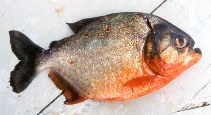
Body shape (shape guide): short and / or deep; Cross section: compressed.
Common in creeks and interconnected ponds in Matto Grosso, Brazil, where it influences distribution and feeding of other fish (Ref. 9080) and in areas of high primary production in Rio Machado and Rio Negro (Ref.9096). Adults feed mainly at dusk and dawn on insects, worms and fish (Ref. 7020). Medium-sized to large individuals (15-24 cm length) forage mainly at dawn, late afternoon and night up to about 2200H, whereas smaller fish (8-11 cm) are active mainly during the day (Ref. 9080). Teeth replacement on alternating sides of jaw allows continuous feeding. Its powerful dentition can inflict serious bites. Has a highly evolved auditory capacity and a 'lurking', then 'dashing' behavior during daytime. Shows hierarchies within small schools (Ref. 9077). Available information on body composition of 'piranha caju' flesh is 8.2% fat, 15.0% protein and 4.4% ash (Ref. 9251).
在 Matto Grosso 巴西的常見於小溪與相連的池塘, 在那裡它影響其他魚 (參考文獻 9080) 的分布與進食與在 Rio Machado 與尼格羅河的高原始產量的區域中.(參考文獻 9096) 成魚主要地在薄暮與破曉吃。 吃昆蟲,蠕蟲與魚。 (參考文獻 7020) 中等大小到大的個體 (15-24 公分長度) 主要地在破曉覓食,午後接近傍晚與夜晚達到大約 2200H, 然而較小的魚 (8-11 公分) 主要地在白天期間是活躍的.(參考文獻 9080) 在頜的交互側邊上的齒替換允許連續的進食。 它的有力的牙齒能施放嚴重的咬。 高度地有一個進化聽覺的能力與一 '潛藏 ', 然後 ' 活耀的' 在白天期間的行為。 小群魚群裡面的顯示階級組織.(參考文獻 9077) '食人魚 caju' 肉的有用關於身體組織成分的資訊是 8.2% 脂肪, 15.0% 蛋白質與 4.4% 灰。 (參考文獻 9251)
生命週期和交配行為
成熟度 | 繁殖 | 產卵場 | 卵 | 孕卵數 | 仔魚
Males and females appear externally alike (Refs. 2279 & 9245). In 'Serrasalmus sp. aff. nattereri', reported to occur in the Orinoco basin (Venezuela, Guyana), the males have more 'bull-like' heads, but are more slender than females (Ref. 1672). Eggs are laid on tree roots trailing in the water and are guarded; the reproductive success may vary strongly from year to year depending on how the savanna was flooded (Ref. 9078). The eggs are large, adhere to plants and are not attacked by the parents. They hatch in 9 to10 days (Ref. 7020).南美洲: 亞馬遜河流域, 巴拉圭- 巴拉納河的流域,巴西東北部沿海的河川, Essequibo 河流域。
Fink, W.L., 1993. Revision of the piranha genus Pygocentrus. Copeia 1993(3):665-687. (Ref. 27142)
IUCN 瀕危狀態 (Ref. 130435: Version 2025-2 (Global))
無危 (LC) ; Date assessed: 21 December 2020
人類使用
漁業: 低經濟; 游釣魚種: 是的; 水族館: 商業性
工具
特別的報告
下載 XML
網路資源
基於模型的估計
系統發育多樣性指數 (參考文獻
82804): PD
50 = 0.5625 [Uniqueness, from 0.5 = low to 2.0 = high].
Bayesian length-weight: a=0.02089 (0.01377 - 0.03170), b=3.16 (3.04 - 3.28), in cm total length, based on LWR estimates for this species & (Sub)family-body (Ref.
93245).
營養階層 (參考文獻
69278): 3.7 ±0.61 se; based on food items.
Generation time: 1.7 ( na - na) years. Estimated as median ln(3)/K based on 1
growth studies.
回復力 (參考文獻
120179): 中等的, 族群倍增時間最少 1.4 - 4.4年 (K=0.89; tm=1; Fec=4,000-5,000).
釣魚的脆弱性 (Ref.
59153): Moderate vulnerability (44 of 100).
🛈
營養素 (Ref.
124155): Calcium = 59.4 [26.7, 161.3] mg/100g; Iron = 2.16 [1.01, 5.44] mg/100g; Protein = 19.6 [17.4, 22.0] %; Omega3 = 0.665 [0.258, 1.848] g/100g; Selenium = 32.6 [11.5, 81.7] μg/100g; VitaminA = 14.8 [3.9, 59.4] μg/100g; Zinc = 0.783 [0.500, 1.228] mg/100g (wet weight);