การจำแนกประเภท / ชื่อ
ชื่อสามัญ | ชื่อพ้อง | Catalog of Fishes(สกุล, ชนิด) | ITIS | CoL | WoRMS | Cloffa
>
Petromyzontiformes (Lampreys) >
Petromyzontidae (Northern lampreys) > Lampetrinae
Etymology: Lampetra: lambo (L.), to lick; petra (Gr.), rock or stone, referring to their suctorial behavior (adults attach to rocks during nest building and mating) (See ETYFish); planeri: In honor of Johann Jacob Planer (1743-1789), German physician, botanist and mycologist, who supplied holotype (See ETYFish).
Eponymy: Professor Dr Johann Jacob Planer (1743–1789) was a German physician and botanist. He gave Bloch the holotype. A genus of American tree, Planera, is named after him. (Ref. 128868), visit book page.
More on author: Bloch.
Taxonomic Remarks
Rembiszewski (1968) reported on three adult hybrids between L. planeri and Eudontomyzon mariae in the Jeziorka River, Poland (Ref. 89241).
สิ่งแวดล้อม : สิ่งแวดล้อม / เขตภูมิอากาศ / ระดับความลึก / ระยะการกระจายสินค้า
นิเวศวิทยา
; น้ำจืด สัตว์น้ำหน้าดิน; สัตว์น้ำจืดที่มีการอพยพอย่างแท้จริงภายในแหล่งน้ำจืดเท่านั้น (Ref. 138297). Subtropical; 1°C - 15°C (Ref. 12315); 68°N - 36°N, 10°W - 50°E
Europe: Great Britain north to Scottish highlands, rivers draining to North Sea north to Scotland and about Stavanger (Norway), Baltic Sea basin, Atlantic as far south as Adour drainage (France, Spain) and isolated populations in Sado, Tagus and Douro drainages (Portugal), Mediterranean basin in France and western Italy (south to about Cilento drainage). Locally in Ireland, upper Volga, upper Danube and some of their tributaries and Pescara drainage on Adriatic coast of Italy.
ความยาวเมื่อครบกำหนดครั้งแรก / ขนาด / น้ำหนัก / อายุ
วัยเจริญพันธุ์: Lm 11.5, range 5 - 16 cm
Max length : 20.5 cm TL เพศผู้/กระเทย; (Ref. 88166); common length : 16.0 cm TL เพศผู้/กระเทย; (Ref. 2163); อายุสูงสุดที่ได้รายงาน: 7 ปี (Ref. 12315)
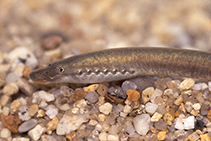
เงี่ยงครีบหลัง (รวม) : 0; ก้านครีบอ่อนที่หาง (รวม) : 0; เงี่ยงครีบก้น: 0; ก้านครีบอ่อนที่ก้น: 0. Poorly developed fins, dorsal fins in contact in mature adults, blue-green back, yellow flanks, white ventral portion (Ref. 2163). Diagnostic features: Adults: 8.6-17.0 cm TL. Body proportions, as percentage of TL (based on 16 specimens measuring 10.6-13.3 cm TL): prebranchial length, 10.9-12.6; branchial length, 7.5-9.9; trunk length, 44.4-53.3; tail length, 25.4-31.4; eye length, 2.3-2.9; disc length, 5.2-7.0. Urogenital papilla length, as a percentage of branchial length, in ten spawning males measuring 11.1-14.0 cm TL, 21.4-52.6. Trunk myomeres, 60-65. Dentition: supraoral lamina, 2 unicuspid teeth; infraoral lamina, 7-9 teeth, usually all unicuspid, but occasionally one lateralmost bicuspid; 3 endolaterals on each side; endolateral formula, typically 2-3-2; 2 rows of anterials; first row of anterials, 9 unicuspid teeth; exolaterals absent; posterials absent; transverse lingual lamina, 9-13 unicuspid teeth, the median one enlarged; longitudinal lingual laminae each with about 9 unicuspid teeth. Velar tentacles, 4-6, with tubercles. Body coloration (preserved), dorsal and lateral aspects grayish, ventral surface whitish, dorsal fins and caudal fin yellowish. Some specimens display a prominent dark blotch at the apex of the second dorsal fin. The iris is yellow. Lateral line neuromasts unpigmented. Unpigmented caudal fin except for spawning individuals in which it is "weakly peppered". Caudal fin shape, spade-like (Ref. 89241). Sigmund Freud (Ref. 72450, 72451 ) described the development of the central nervous system of brook lamprey.
Body shape (shape guide): eel-like.
Adults are found in the lowland, piedmont and montane zone in clear, well oxygenated brooks (Ref. 59043). They live exclusively in freshwater; in middle and upper reaches of small streams and rivers, occasionally in lakes. Larvae lie buried in the substrate while adults live in the open water (Ref. 57699). Sexually mature adults have been observed burrowing in fine sand (Ref. 89241). Larvae of this species can serve as mid-term bio-indicators (Ref. 57699). They live in detritus-rich sands or clay sediments (Ref. 59043). Larval life is 5+ to 6+ years, with the smaller individuals of the latter year class delaying metamorphosis by one year. Metamorphosis occurs in September in the Czech Republic (Ref. 89241). Filter feeding larvae, non-feeding adults (= non-parasitic). Reproduction takes place upstream, from April to May (Ref. 30578). Duration of the life cycle is believed to last 6 years on average. Communal spawning in the same redd by L. fluviatilis and L. planeri has been reported in the River Tywi Basin, Wales (UK), in April, at a water temperature of 11 °C. Both species participated in constructing a redd about 23 cm in diameter and 5-8 cm deep, consisting of pebbles, gravel, and coarse sand. In the river Yeo, England (UK), peak spawning activity varies between 26 March and 24 April when water temperatures reach 10-11 °C. As the spawning season progresses, male:female ratios shift from 3.54:1 to 1.60:1. In the Czech Republic, both sexes participate in the redd construction in shady areas of streams that are 1-8 m in width and a few centimeters to 0.8 m in depth. Spawning occurs between 1 and 17 June at water currents 1-4 m/s and water temperatures 10-16 °C (Ref. 89241). Because of its small size and the mediocre quality of its meat, it is rarely fished. The larvae are utilized as bait (Ref. 30578).
The female attaches with her oral disc to a rock at the upstream end of the nest. The male attaches to the back of her head using his oral disc and wraps his tail around her trunk region in such a way as to have each others urogenital papilla in close proximity and through muscular contraction of his body assists in the extrusion of the eggs. They vibrate
vigorously for a few seconds. This results in the release of their gametes and disturbance of the substrate, which partially buries the fertilized eggs.
They build small depressions in the gravel in the river bed in which they spawn. Adults die after spawning. Larvae hatch after 3-4 days.
Hardisty, M.W., 1986. Lampetra planeri (Bloch 1784). p. 279-304. In J. Holcík (ed.) The Freshwater fishes of Europe. Vol. 1, Part 1. Petromyzontiformes. (Ref. 12315)
สถานะบัญชีแดงของ IUCN (Ref. 130435: Version 2025-2 (Global))
ภัยคุกคามต่อมนุษย์
Harmless
การใช้ของมนุษย์
การประมง: ไม่มีผลประโยชน์; สถานที่แสดงสัตว์และพืชน้ำ: สถานแสดงสัตว์น้ำของรัฐ; เหยื่อ: usually
เครื่องมือ
รายงานพิเศษ
ดาวน์โหลด XML
แหล่งที่มาจากอินเตอร์เน็ต
การประมาณค่าตามแบบจำลอง
ดัชนีความหลากหลายทางวิวัฒนาการ (อ้างอิง
82804): PD
50 = 0.5010 [Uniqueness, from 0.5 = low to 2.0 = high].
Bayesian length-weight: a=0.00158 (0.00087 - 0.00290), b=2.92 (2.75 - 3.09), in cm total length, based on LWR estimates for this species & (Sub)family-body (Ref.
93245).
ระดับชั้นอาหาร (อ้างอิง
69278): 3.5 ±0.4 se; based on size and trophs of closest relatives
Generation time: 6.7 ( na - na) years. Estimated as median ln(3)/K based on 1
growth studies.
ความสามารถในการกลับคืนสู่ปกติ (อ้างอิง
120179): ต่ำ, เวลาต่ำสุดที่จะทำให้ประชากรเพิ่มขึ้นเป็น 2 เท่าใช้เวลา 4.5 - 14 ปี (Semelparous species, assuming tm (= tmax) > 4).
ความเสี่ยงต่อการตกปลา (Ref.
59153): Moderate vulnerability (45 of 100).
🛈