Klassifizierung / Names
Namen | Synonyme | Catalog of Fishes(Gattung, Arten) | ITIS | CoL | WoRMS | Cloffa
>
Cypriniformes (Carps) >
Cyprinidae (Minnows or carps) > Smiliogastrinae
Etymology: Dawkinsia: Named for Richard Dawkins, for his contribution to the public understanding of science and, in particular, of evolutionary science.
Eponymy: Dr Clinton Richard Dawkins (d: 1941) is an ethologist and evolutionary biologist who was Professor for Public Understanding of Science (1995–2008) at Oxford, which had awarded both his bachelor’s degree (1962) and his doctorate (1966) and where he [...] (Ref. 128868), visit book page.
More on author: Valenciennes.
Umwelt: Milieu / Klimazone / Tiefenbereich / Verbreitungsgebiet
Ökologie
; süßwasser; brackwasser benthopelagisch; pH range: 6.0 - 6.5; dH range: ? - 15. Tropical; 20°C - 24°C (Ref. 1672)
Asia: India
Größe / Gewicht / Alter
Geschlechtsreife: Lm ? range ? - ? cm
Max length : 18.0 cm TL Männchen/unbestimmt; (Ref. 41236); common length : 11.0 cm TL Männchen/unbestimmt; (Ref. 41236)
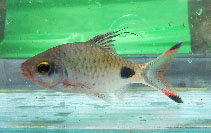
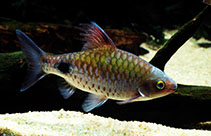
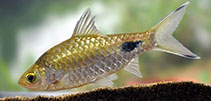
Adults differ from all other South Asian Puntius by a combination of the following characters: branched dorsal-fin rays prolonged into filament-like extensions in adult males only; a black band about as wide as the eye near tip of each caudal-fin lobe; lower lip continuous; a caudal blotch on 2-5 scales, commencing posterior to anal-fin origin; no distinct markings on body in advance of anal-fin origin. Distinguished from P. assimilis by possessing a subterminal mouth (vs. Inferior); maxillary barbels shorter, 0.5-2.2 of SL % (vs. 5.5-9.3%); post-orbital head length 11.0-12.1% of SL (vs. 8.7-10.4%); and interorbital width 11.2-12.2% of SL (vs. 10.0-11.1%) (Ref. 55036).
Body shape (shape guide): fusiform / normal.
Adults occur in clear streams, lakes and ponds (Ref. 41236). They inhabit lowland rivers and also estuaries, reservoirs and marshes (Ref. 55036). Migratory behaviour is undetermined (Ref. 126106).
Lebenszyklus und Paarungsverhalten
Geschlechtsreife | Fortpflanzung | Ablaichen | Eier | Fruchtbarkeit | Larven
Pethiyagoda, R. and M. Kottelat, 2005. A review of the barb of the Puntius filamentosus group (Teleostei: Cyprinidae) of southern India and Sri Lanka. Raffles Bull. Zool. Suppl. 12:127-144. (Ref. 55036)
IUCN Rote Liste Status (Ref. 130435: Version 2025-2 (Global))
Bedrohung für Menschen
Harmless
Nutzung durch Menschen
Fischereien: kommerziell; Aquarium: Kommerziell
Tools
Zusatzinformationen
Download XML
Internet Quellen
Schätzungen auf der Grundlage von Modellen
Phylogenetischer Diversitätsindex (Ref.
82804): PD
50 = 0.5001 [Uniqueness, from 0.5 = low to 2.0 = high].
Bayesian length-weight: a=0.00912 (0.00563 - 0.01478), b=2.98 (2.84 - 3.12), in cm total length, based on LWR estimates for this species & (Sub)family-body (Ref.
93245).
Trophische Ebene (Ref.
69278): 2.6 ±0.0 se; based on diet studies.
Widerstandsfähigkeit (Ref.
120179): hoch, Verdopplung der Population dauert weniger als 15 Monate. (Preliminary K or Fecundity.).
Anfälligkeit der Fischerei (Ref.
59153): Low vulnerability (10 of 100).
🛈