>
Eupercaria/misc (Various families in series Eupercaria) >
Haemulidae (Grunts) > Plectorhinchinae
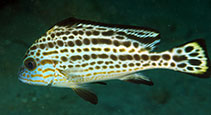
Etymology: Diagramma: Greek, diagramma = mark out by lines (Ref. 45335).
Umwelt: Milieu / Klimazone / Tiefenbereich / Verbreitungsgebiet
Ökologie
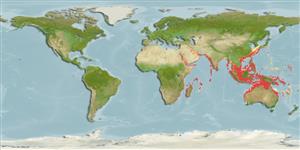
seewasser riff-verbunden; standorttreu; tiefenbereich 1 - 170 m (Ref. 12260), usually 1 - 50 m (Ref. 37816). Tropical; 35°N - 35°S, 25°E - 170°E
Indo-West Pacific: Arabian and Mozambique channel eastward to Gulf to Palau north to Japan south to New Caledonia.
Länge bei der ersten Reifung / Größe / Gewicht / Alter
Geschlechtsreife: Lm 31.8 range ? - ? cm
Max length : 100.0 cm FL Männchen/unbestimmt; (Ref. 3678); common length : 55.0 cm TL Männchen/unbestimmt; (Ref. 5450); max. veröff. Gewicht: 6.3 kg (Ref. 4699); max. veröff. Alter: 13 Jahre (Ref. 94052)
Rückenflossenstacheln (insgesamt) : 9 - 10; Rückenflossenweichstrahlen (insgesamt) : 21 - 25; Afterflossenstacheln: 3; Afterflossenweichstrahlen: 7.
Body shape (shape guide): fusiform / normal; Cross section: compressed.
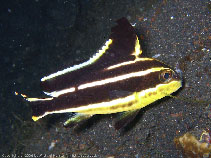
Typically found solitary or in groups, often in turbid water. on open muddy, sandy or silty substrates in protected bays or estuaries, around rock outcrops, wreckage and debris (Ref. 48635, 90102). Also in shallow coastal areas and coral reefs (Ref. 30573). Juveniles are found in weedy areas (Ref. 2799). Feeds on benthic invertebrates and fishes (Ref. 30573). Reportedly ciguatoxic in some areas (Ref. 2799). Marketed fresh and frozen (Ref. 9987).
Distinct pairing during breeding (Ref. 205).
Parenti, P., 2019. An annotated checklist of the fishes of the family Haemulidae (Teleostei: Perciformes). Iran. J. Ichthyol. 6(3):150-196. (Ref. 119443)
IUCN Rote Liste Status (Ref. 130435: Version 2025-2 (Global))
Bedrohung für Menschen
Reports of ciguatera poisoning (Ref. 2799)
Nutzung durch Menschen
Fischereien: kommerziell; Sportfisch: ja; Aquarium: Kommerziell
Tools
Zusatzinformationen
Download XML
Internet Quellen
Schätzungen auf der Grundlage von Modellen
Bevorzugte Temperatur (Ref.
123201): 24.1 - 29.1, mean 28 °C (based on 2894 cells).
Phylogenetischer Diversitätsindex (Ref.
82804): PD
50 = 0.5625 [Uniqueness, from 0.5 = low to 2.0 = high].
Bayesian length-weight: a=0.01202 (0.00960 - 0.01505), b=2.99 (2.93 - 3.05), in cm total length, based on LWR estimates for this species (Ref.
93245).
Trophische Ebene (Ref.
69278): 3.7 ±0.2 se; based on diet studies.
Widerstandsfähigkeit (Ref.
120179): niedrig, Verdopplung der Population dauert 4,5 - 14 Jahre. (K=0.17; tm=3-4; tmax=13; Fec=495,450).
Prior r = 0.64, 95% CL = 0.42 - 0.96, Based on 2 data-limited stock assessments.
Anfälligkeit der Fischerei (Ref.
59153): Moderate vulnerability (45 of 100).
🛈
Klimaanfälligkeit (Ref.
125649): Very high vulnerability (86 of 100).
🛈
Nährstoffe (Ref.
124155): Calcium = 20.7 [9.2, 56.8] mg/100g; Iron = 0.444 [0.192, 1.089] mg/100g; Protein = 19.7 [17.4, 21.9] %; Omega3 = 0.111 [0.056, 0.223] g/100g; Selenium = 47.2 [19.2, 128.6] μg/100g; VitaminA = 43.6 [18.7, 100.4] μg/100g; Zinc = 0.485 [0.279, 1.231] mg/100g (wet weight); based on
nutrient studies.