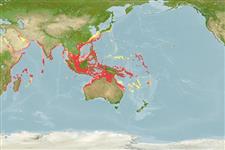
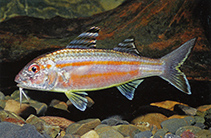
Environnement : milieu / zone climatique / profondeur / gamme de distribution
Écologie
marin; saumâtre démersal; océanodrome (Ref. 51243); profondeur 10 - 90 m (Ref. 12260), usually 20 - 60 m (Ref. 114285). Tropical; 36°N - 28°S, 33°E - 180°E
Indo-West Pacific: East Africa to southeast Asia, north to China, south to northern Australia and Fiji (Ref. 12743).
Longueur à la première maturité / Taille / Poids / Âge
Maturité: Lm 9.9, range 9 - 10.3 cm
Max length : 23.0 cm TL mâle / non sexé; (Ref. 30573); common length : 20.0 cm TL mâle / non sexé; (Ref. 5450)
Épines dorsales (Total) : 8; Rayons mous dorsaux (Total) : 9; Épines anales: 1; Rayons mous anaux: 7. This species is distinguished by the following characters: D VIII,9; pectoral fins 15-16; gill rakers 7-8 + 19-21 = 27-28; lateral line scales 34-37; body depth at first dorsal-fin origin 29-33% SL and at anus 25-27% SL; caudal-peduncle depth 11-12% SL; maximum head depth 23-25% SL; head depth through eye 18-20% SL; head length 29-30%SL; orbit length 7.4-8.7% SL; upper jaw length 11-13% SL; barbel length 17-21% SL; caudal-fin length 27-30% SL; anal-fin height 16-18% SL; pelvic-fin length 20-22% SL; pectoral-fin length 24-26% SL; first dorsal-fin height 23-26% SL; second dorsal-fin height 17-18% SL; no bars on caudal-fin lobes; yellowish lower lobe base, grey on upper lobe (some of the caudal-fin lobe pigmentation retained when preserved, including inner margin of fin lobes); 2 yellow body stripes, 1 mid-lateral body from operculum to caudal-fin base (both faintly retained in preserved fish); white barbels; body dorsally pale brown and ventrally white (pale brown with some reddish or darker brown area at mid-body in preserved fish) (Ref. 82903).
Body shape (shape guide): fusiform / normal; Cross section: oval.
Found in coastal waters, entering estuaries (Ref. 30573). Sandy-muddy bottom (Ref. 43239). Forms schools (Ref. 5213). Has appearance of sillaginids when schooling (Ref. 48636).
Cycle de vie et comportement reproducteur
Maturité | Reproduction | Frai | Œufs | Fécondité | Larves
Kumaran, M. and J.E. Randall, 1984. Mullidae. In W. Fischer and G. Bianchi (eds.) FAO species identification sheets for fishery purposes. Western Indian Ocean fishing area 51. Vol. 3. (Ref. 3470)
Statut dans la liste rouge de l'IUCN (Ref. 130435: Version 2025-2 (Global))
Menace pour l'homme
Harmless
Utilisations par l'homme
Pêcheries: intérêt commercial mineur; Aquarium: Commercial
Outils
Articles particuliers
Télécharger en XML
Sources Internet
Estimations basées sur des modèles
Température préférée (Réf.
123201): 24.3 - 29.1, mean 28 °C (based on 1552 cells).
Indice de diversité phylogénétique (Réf.
82804): PD
50 = 0.5000 [Uniqueness, from 0.5 = low to 2.0 = high].
Bayesian length-weight: a=0.01023 (0.00859 - 0.01219), b=3.09 (3.06 - 3.12), in cm total length, based on LWR estimates for this species (Ref.
93245).
Niveau trophique (Réf.
69278): 3.1 ±0.1 se; based on diet studies.
Generation time: 1.1 (0.9 - 1.4) years. Estimated as median ln(3)/K based on 22
growth studies.
Résilience (Réf.
120179): Faible, temps minimum de doublement de population : 4,5 à 14 années (K=0.5-1.3; tmax=4.6).
Prior r = 0.52, 95% CL = 0.35 - 0.79, Based on 1 data-limited stock assessment.
Vulnérabilité de la pêche (Ref.
59153): Low vulnerability (15 of 100).
🛈
Nutriments (Ref.
124155): Calcium = 233 [126, 477] mg/100g; Iron = 1.33 [0.62, 2.35] mg/100g; Protein = 17.4 [15.4, 19.7] %; Omega3 = 0.302 [0.178, 0.562] g/100g; Selenium = 58.1 [32.3, 117.3] μg/100g; VitaminA = 17.5 [6.6, 50.9] μg/100g; Zinc = 1.66 [1.06, 2.32] mg/100g (wet weight);