>
Blenniiformes (Blennies) >
Blenniidae (Combtooth blennies) > Salariinae
Etymology: Cirripectes: Latin, cirrus = curl fringe + Greek, pektos, -e, -on = made of several parts solidly united (Ref. 45335); obscurus: Specific epithet 'obscurus' meaning dark, refers to the dark coloration of the fish.
More on author: Borodin.
Environnement : milieu / zone climatique / profondeur / gamme de distribution
Écologie
marin récifal; profondeur 0 - 6 m (Ref. 529). Tropical; 30°N - 20°N
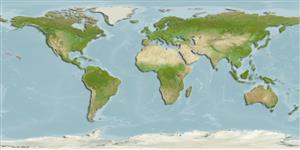
Eastern Central Pacific: native to the Hawaiian Islands (Ref. 3921) and Midway Islands (Ref. 28618).
Longueur à la première maturité / Taille / Poids / Âge
Maturité: Lm ?, range 11 - ? cm
Max length : 13.4 cm SL mâle / non sexé; (Ref. 529)
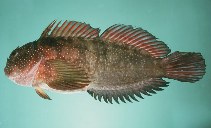
Épines dorsales (Total) : 11 - 12; Rayons mous dorsaux (Total) : 15 - 17; Épines anales: 2; Rayons mous anaux: 16 - 17; Vertèbres: 31 - 33. Diagnosis: Dorsal fin XII, 16, membrane attached to caudal fin, with deep notch above last spine, first spine almost same or slightly higher than second; anal fin II, 17; pectoral rays 15; pelvic fin I, 4; caudal fin procurrent rays 10-14. Vertebrae 10 + 22. LL, without scales but with scalelike flaps irregularly spaced along anterior part of LL; LL tubes 0-10 (usually 0-8), canal ends on caudal fin base. Lower lip crenulated mesially but plicate laterally. Upper lip crenulae 41-50. Gill rakers 26-30. Cephalic sensory pore complex. Cirri, supraorbital 10-26, nasal 14-42; nuchal 36-47, grouped into 2 that sometimes overlap at midpoint on nape, without nuchal flaps. Head spotted; behind each eye are pupil-sized dark spots; iris yellowish in females, orange in males; ventral surface reddish brown in males, golden brown in females. Body brown with spots, male with spots not reaching to caudal fin base, female spots white becoming lavender posteriorly up to caudal fin base (Ref. 529).
Body shape (shape guide): fusiform / normal; Cross section: oval.
Facultative air-breathing in the genus (Ref. 126274); Occur in the surge zone of rocky and coral reefs less than 6 m deep (Ref. 529, 9710, 58302). Benthic (Ref. 58302). Oviparous. Eggs are demersal and adhesive (Ref. 205), and are attached to the substrate via a filamentous, adhesive pad or pedestal (Ref. 94114). Larvae are planktonic, often found in shallow, coastal waters (Ref. 94114).
Cycle de vie et comportement reproducteur
Maturité | Reproduction | Frai | Œufs | Fécondité | Larves
Oviparous, distinct pairing (Ref. 205). Urogenital orifice of male genital papilla located at distal tip of a slender filament on a fleshy swelling behind anus; elongated testes with length equal to 2 to 3 times its width (Ref. 529).
Williams, J.T., 1988. Revision and phylogenetic relationships of the blenniid fish genus Cirripectes. Indo-Pac. Fish. (17):78 p. (Ref. 529)
Statut dans la liste rouge de l'IUCN (Ref. 130435: Version 2025-2 (Global))
Menace pour l'homme
Harmless
Utilisations par l'homme
Pêcheries: sans intérêt; Aquarium: Commercial
Outils
Articles particuliers
Télécharger en XML
Sources Internet
Estimations basées sur des modèles
Température préférée (Réf.
123201): 24.3 - 26.5, mean 25.3 °C (based on 53 cells).
Indice de diversité phylogénétique (Réf.
82804): PD
50 = 0.5000 [Uniqueness, from 0.5 = low to 2.0 = high].
Bayesian length-weight: a=0.01047 (0.00463 - 0.02370), b=2.98 (2.79 - 3.17), in cm total length, based on LWR estimates for this (Sub)family-body shape (Ref.
93245).
Niveau trophique (Réf.
69278): 2.0 ±0.00 se; based on food items.
Résilience (Réf.
120179): Haut, temps minimum de doublement de population inférieur à 15 mois (Preliminary K or Fecundity.).
Vulnérabilité de la pêche (Ref.
59153): Low vulnerability (10 of 100).
🛈