Classificazione / Nomi
Nomi Comuni | Sinonimi | Catalog of Fishes(Genere, Specie) | ITIS | CoL | WoRMS | Cloffa
>
Blenniiformes (Blennies) >
Blenniidae (Combtooth blennies) > Salariinae
Etymology: Cirripectes: Latin, cirrus = curl fringe + Greek, pektos, -e, -on = made of several parts solidly united (Ref. 45335); jenningsi: Named for Mr. Jennings of Swains Island.
Eponymy: Alexander Hutchinson Jennings (ca: 1896–1958) was the grandson of Eli Hutchinson Jennings who took possession of Swains Island, American Samoa (1856). [...] (Ref. 128868), visit book page.
More on author: Schultz.
Ambiente: milieu / zona climatica / distribuzione batimetrica / gamma di distribuzione
Ecologia
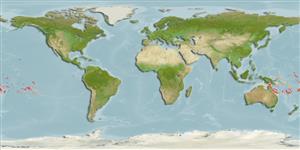
marino demersale; distribuzione batimetrica 0 - 10 m. Tropical; 5°N - 25°S
Pacific Ocean: Gilbert Islands to the Tuamoto Islands.
Lunghezza alla prima maturità / Dimensione / Peso / Età
Maturità: Lm ?, range 4 - ? cm
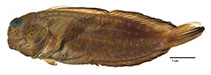
Max length : 7.6 cm SL maschio/sesso non determinato; (Ref. 529)
Spine dorsali (totale) : 12 - 13; Raggi dorsali molli (totale) : 15 - 16; Spine anali: 2; Raggi anali molli: 15 - 17; Vertebre: 31 - 32. Diagnosis: Dorsal fin XII, 15, membrane attached to caudal fin, with deep notch above last spine, first spine almost same or slightly higher than second; anal fin II, 16; pectoral rays 15; pelvic fin I, 4; caudal fin procurrent rays 10-14. Vertebrae 10 + 21. LL, without scales and scalelike flaps; LL tubes 2-11 (usually 5-9), canal ends below 15th dorsal ray to caudal-fin base. Upper lip crenulae 41-47. Gill rakers 19-24. Cephalic sensory pore complex. Cirri, supraorbital 2-4, nasal 8-19; nuchal 34-44, row uninterrupted, without nuchal flap, cirri connected at their bases by a membranous ridge. Adults and juveniles anterior body light rose with black spots and 2 broad bars, posteriorly dark purple or blue with white spots, cirri pale. Ophioblennius overall cream with small dark brown spot on posterior of lower lip (in alcohol) (Ref. 529).
Body shape (shape guide): fusiform / normal; Cross section: oval.
Facultative air-breathing in the genus (Ref. 126274); Adults inhabit shallow coral reefs (Ref. 529). Oviparous. Eggs are demersal and adhesive (Ref. 205), and are attached to the substrate via a filamentous, adhesive pad or pedestal (Ref. 94114). Larvae are planktonic, often found in shallow, coastal waters (Ref. 94114).
Ciclo vitale e comportamento di accoppiamento
Maturità | Riproduzione | Deposizione | Uova | Fecondità | Larve
Oviparous, distinct pairing (Ref. 205). Urogenital orifice of male genital papilla located basally behind a single slender filament on a fleshy swelling behind anus; testes bulbous with length equal to its width (Ref. 529).
Williams, J.T., 1988. Revision and phylogenetic relationships of the blenniid fish genus Cirripectes. Indo-Pac. Fish. (17):78 p. (Ref. 529)
Stato della Lista Rossa IUCN (Ref. 130435: Version 2025-2 (Global))
Minaccia per l'uomo
Harmless
Usi umani
Pesca: di nessun interesse
Strumenti
Rapporti speciali
Scarica XML
Fonti Internet
Stime basate su modelli
Temperatura preferita (Fonte Biblio.
123201): 25.2 - 29.1, mean 27.4 °C (based on 304 cells).
Indice di diversità filogenetica (Fonte Biblio.
82804): PD
50 = 0.5000 [Uniqueness, from 0.5 = low to 2.0 = high].
Bayesian length-weight: a=0.01047 (0.00463 - 0.02370), b=2.98 (2.79 - 3.17), in cm total length, based on LWR estimates for this (Sub)family-body shape (Ref.
93245).
Livello trofico (Fonte Biblio.
69278): 2.0 ±0.00 se; based on food items.
Resilienza (Fonte Biblio.
120179): Alto, tempo minimo di raddoppiamento della popolazione meno di 15 mesi (Preliminary K or Fecundity.).
Vulnerabilità della pesca (Ref.
59153): Low vulnerability (10 of 100).
🛈