Ambiente: milieu / zona climatica / distribuzione batimetrica / gamma di distribuzione
Ecologia
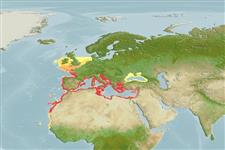
marino benthopelagico; distribuzione batimetrica 0 - 200 m (Ref. 3688), usually 15 - 50 m (Ref. 54220). Subtropical; 56°N - 12°N, 23°W - 42°E (Ref. 54220)
Eastern Atlantic: British Isles to Cape Blanc, Mauritania; (exceptionally further south) Senegal and around the Canary Islands and Madeira. Common south of 40°N (Spain, North Africa) in the Mediterranean (Ref. 4781).
Lunghezza alla prima maturità / Dimensione / Peso / Età
Maturità: Lm 34.6 range ? - ? cm
Max length : 100.0 cm TL maschio/sesso non determinato; (Ref. 3397); common length : 50.0 cm TL maschio/sesso non determinato; (Ref. 3688); peso massimo pubblicato: 14.3 kg (Ref. 40637)
Breve descrizione
Chiavi di identificazione | Morfologia | Morfometria
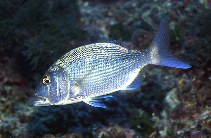
Spine dorsali (totale) : 11; Raggi dorsali molli (totale) : 11 - 12; Spine anali: 3; Raggi anali molli: 7 - 9. Body oval and compressed. Canine teeth, with 4 to 6 anterior teeth very developed in each jaw.
Body shape (shape guide): fusiform / normal; Cross section: oval.
Inhabit hard bottoms (rock or rubble) down to 200 m depth. Usually found in shallow water less than 50 m deep (Ref. 9987). Adults solitary; young gregarious (Ref. 12482). Young fish caught with traps. Feed on fish, mollusks and cephalopods. Important food fish. Marketed fresh or frozen (Ref. 9987). Some attempts to culture this species have been successful. Due to low market supply, the potential for selling these fish from aquaculture operations seems to be good (Ref. 9987). A spear-fisherman cites a specimen caught in Greece (Corfu) with an overnight bottom-line about 1.60 m and 42 kg (Ref. 48271), but the identification cannot be verified.
Ciclo vitale e comportamento di accoppiamento
Maturità | Riproduzione | Deposizione | Uova | Fecondità | Larve
Gonochoric, but some specimens are hermaphroditic. Species of separated sexes (although some individuals may be hermaphrodite in young stages). In the Mediterranean, reproduction takes place between March and May, in areas near the coast. Embryo development lasts about 3 days at 17°C.
Bauchot, M.-L. and J.-C. Hureau, 1990. Sparidae. p. 790-812. In J.C. Quero, J.C. Hureau, C. Karrer, A. Post and L. Saldanha (eds.) Check-list of the fishes of the eastern tropical Atlantic (CLOFETA). JNICT, Lisbon; SEI, Paris; and UNESCO, Paris. Vol. 2. (Ref. 3688)
Stato della Lista Rossa IUCN (Ref. 130435: Version 2025-2 (Global))
Minaccia per l'uomo
Harmless
Usi umani
Pesca: commerciale; Acquacoltura: commerciale; Pesce da pesca sportiva: si
Strumenti
Rapporti speciali
Scarica XML
Fonti Internet
Stime basate su modelli
Temperatura preferita (Fonte Biblio.
123201): 13.3 - 21.1, mean 18.1 °C (based on 298 cells).
Indice di diversità filogenetica (Fonte Biblio.
82804): PD
50 = 0.5001 [Uniqueness, from 0.5 = low to 2.0 = high].
Bayesian length-weight: a=0.01122 (0.00965 - 0.01305), b=3.02 (2.99 - 3.05), in cm total length, based on LWR estimates for this species (Ref.
93245).
Livello trofico (Fonte Biblio.
69278): 4.5 ±0.4 se; based on diet studies.
Resilienza (Fonte Biblio.
120179): Basso, tempo minimo di raddoppiamento della popolazione 4.5 - 14 anni (K=0.1; tm=2-3).
Prior r = 0.39, 95% CL = 0.26 - 0.58, Based on 9 data-limited stock assessments.
Vulnerabilità della pesca (Ref.
59153): High to very high vulnerability (66 of 100).
🛈
Vulnerabilità climatica (Ref.
125649): High vulnerability (63 of 100).
🛈
Nutrienti (Ref.
124155): Calcium = 30.5 [16.1, 58.0] mg/100g; Iron = 0.656 [0.354, 1.189] mg/100g; Protein = 19.7 [18.2, 21.3] %; Omega3 = 0.417 [0.267, 0.640] g/100g; Selenium = 37.2 [16.4, 73.5] μg/100g; VitaminA = 15.4 [4.0, 56.7] μg/100g; Zinc = 0.558 [0.381, 0.828] mg/100g (wet weight); based on
nutrient studies.