>
Blenniiformes (Blennies) >
Blenniidae (Combtooth blennies) > Salariinae
Etymology: Cirripectes: Latin, cirrus = curl fringe + Greek, pektos, -e, -on = made of several parts solidly united (Ref. 45335); auritus: Name from Latin 'auritus', meaning 'eared', referring to the earlike nuchal flap on either side of the head.
Môi trường: môi trường / vùng khí hậu / Mức độ sâu / phạm vi phân phối
Sinh thái học
biển cùng sống ở rạn san hô; mức độ sâu 0 - 20 m (Ref. 630), usually 0 - 10 m (Ref. 529). Tropical; 20°N - 35°S
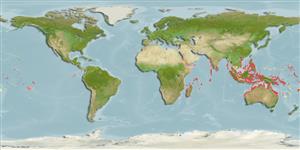
Indo-West Pacific: Kenya to South Africa, then Similan Islands (Thailand), Philippines and the Line Islands.
Chiều dài lúc trưởng thành đầu tiên / Bộ gần gũi / Khối lượng (Trọng lượng) / Tuổi
Chín muồi sinh dục: Lm ?, range 5 - ? cm
Max length : 7.1 cm SL con đực/không giới tính; (Ref. 529)
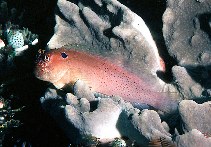
Các tia vây lưng cứng (tổng cộng) : 12 - 13; Các vây lưng mềm (tổng cộng) : 15 - 17; Tia cứng vây hậu môn: 2; Tia mềm vây hậu môn: 16 - 18; Động vật có xương sống: 31 - 33. Diagnosis: Dorsal fin XII-XIII, 15-17 (usually XII,17), entire, only slightly or not at all incised above last spine, first spine equal to second; anal fin II, 15-16; pectoral rays 14; pelvic fin I, 4; caudal fin procurrent rays 10-13. Body depth at anal-fin origin 4.8-5.1 in SL. Vertebrae 10 + 21-23; vertebral centrum, last pleural ribs 11-12, last epipleural rib 17-19. Without scales and scalelike flaps. LL tubes 7-12, series ends below dorsal fin rays 5-13. Lower lip smooth mesially, plicate laterally. Upper lip crenulae 34-39. Gill rakers 21-25. Cirri, nuchal 22-34, supraorbital 2-7, nasal 4-6. Nuchal cirri minute, 5-8 independently distributed, in 2 greatly expanded flaps on each side of nape. Nuchal flaps black. Inner ring of iris yellow, outer ring reddish brown. Body coloration of adults variable (varies in different areas and may also vary between sexes); may be pale, brown, or mottled pale and brown background but always with tiny dark spots on posterior 1/2 to 3/4 of the body and with pale spots or streaks from orbit to upper lip. Similan and Fanning Islands females head mottled strongly with reddish-brown and pinkish-white spots and streaks, body with broad irregular brown bars; in Fanning Islands the pale areas in the head are all faint pink and interspaces on body are cream or light brown instead of faint pink as in those from Similan Islands. Males in Fanning I. are also mottled but in Indian Ocean only females are mottled. Philippines female has uniformly dark brown color. South African males with darker cirri than those from other localities. Meristic and morphometric patterns does not vary geographically. Body depth at anal fin origin 4.8-5.1 in SL (Ref. 529, 90102). Ophioblennius stage overall cream; mouth area without spots; cirri and nuchal flap pale; fins transluscent (in alcohol); with 2 canines on each dentary, posteriorly (Ref. 529). (Ref. 529).
Body shape (shape guide): elongated; Cross section: oval.
Facultative air-breathing in the genus (Ref. 126274); Found on coral rocks, some on sandy bottom in water about 5 m deep or on irregular rocky bottom with sparse live coral and no sand (Ref. 630). Also in shallow protected reefs with rich coral and algae growth, usually found at depths less than about 10 m; occasionally deeper. Usually seen solitary (Ref. 48636). One specimen taken from 20 m in the Comoro Island. Oviparous. Eggs are demersal and adhesive (Ref. 205), and are attached to the substrate via a filamentous, adhesive pad or pedestal (Ref. 94114). Larvae are planktonic, often found in shallow, coastal waters (Ref. 94114).
Oviparous, distinct pairing (Ref. 205). Urogenital orifice of male genital papilla located basally between 2 widely separated slender filaments on a fleshy swelling behind anus; testes bulbous with length equal to width (Ref. 529).
Williams, J.T., 1988. Revision and phylogenetic relationships of the blenniid fish genus Cirripectes. Indo-Pac. Fish. (17):78 p. (Ref. 529)
Tình trạng Sách đỏ IUCN (Ref. 130435: Version 2025-2 (Global))
Mối đe dọa đối với con người
Harmless
Sử dụng của con người
Các nghề cá: không ích lợi (thú vị)
Các công cụ
Báo cáo đặc biệt
Tải xuống XML
Các nguồn internet
Ước tính dựa trên mô hình
Nhiệt độ ưa thích (Tài liệu tham khảo
123201): 25.4 - 29.3, mean 28.5 °C (based on 2513 cells).
Chỉ số đa dạng phát sinh loài (Tài liệu tham khảo
82804): PD
50 = 0.5000 [Uniqueness, from 0.5 = low to 2.0 = high].
Bayesian length-weight: a=0.00776 (0.00354 - 0.01702), b=3.00 (2.81 - 3.19), in cm total length, based on LWR estimates for this (Sub)family-body shape (Ref.
93245).
Mức dinh dưỡng (Tài liệu tham khảo
69278): 2.0 ±0.00 se; based on food items.
Thích nghi nhanh (Tài liệu tham khảo
120179): Chiêù cao, thời gian nhân đôi của chủng quần tối thiểu là dưới 15 tháng (Preliminary K or Fecundity.).
Sự dễ bị tổn thương của nghề đánh cá (Ref.
59153): Low vulnerability (10 of 100).
🛈
Chất dinh dưỡng (Ref.
124155): Calcium = 189 [90, 334] mg/100g; Iron = 0.92 [0.52, 1.66] mg/100g; Protein = 17.8 [16.5, 18.9] %; Omega3 = 0.0885 [, ] g/100g; Selenium = 23.9 [10.8, 56.6] μg/100g; VitaminA = 130 [31, 544] μg/100g; Zinc = 2.93 [1.88, 4.33] mg/100g (wet weight);