Environnement : milieu / zone climatique / profondeur / gamme de distribution
Écologie
marin récifal. Tropical; 30°N - 10°N
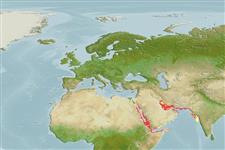
Western Indian Ocean: known only from the Red Sea and the Gulf of Aden.
Taille / Poids / Âge
Maturité: Lm ? range ? - ? cm
Max length : 6.7 cm SL mâle / non sexé; (Ref. 527)
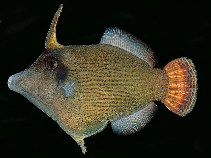
Épines dorsales (Total) : 1; Rayons mous dorsaux (Total) : 29 - 31; Épines anales: 0; Rayons mous anaux: 27 - 28; Vertèbres: 19. Head and body brown; relatively large, black branchial blotch from mid-gill slit to rear border of eye; dusky blotch around eye continued onto forehead and around spinous dorsal base; dark brown iris; pale dusky brown lips. Large pelvic fin rudiment, narrowly attached to posterior margin of ventral flap. Midbody scales with 1-7 spinules, not closely packed; elongate spinules on posterior half of body. Scale spinules on posterior half of body of male very prominent, scale ridge rugosities developing at about 55-65 mm SL.
Body shape (shape guide): short and / or deep; Cross section: compressed.
Occurs in shallow coral reefs to depths of 10 m or more.
Cycle de vie et comportement reproducteur
Maturité | Reproduction | Frai | Œufs | Fécondité | Larves
Hutchins, J.B., 1986. Review of the monacanthid fish genus Pervagor, with descriptions of two new species. Indo-Pac. Fish. (12):35 p. (Ref. 527)
Statut dans la liste rouge de l'IUCN (Ref. 130435: Version 2025-2 (Global))
Menace pour l'homme
Harmless
Utilisations par l'homme
Outils
Articles particuliers
Télécharger en XML
Sources Internet
Estimations basées sur des modèles
Température préférée (Réf.
123201): 25.5 - 29.4, mean 27.9 °C (based on 120 cells).
Indice de diversité phylogénétique (Réf.
82804): PD
50 = 0.5039 [Uniqueness, from 0.5 = low to 2.0 = high].
Bayesian length-weight: a=0.01905 (0.00905 - 0.04012), b=2.93 (2.75 - 3.11), in cm total length, based on LWR estimates for this (Sub)family-body shape (Ref.
93245).
Niveau trophique (Réf.
69278): 2.9 ±0.4 se; based on size and trophs of closest relatives
Résilience (Réf.
120179): Haut, temps minimum de doublement de population inférieur à 15 mois (Preliminary K or Fecundity.).
Vulnérabilité de la pêche (Ref.
59153): Low vulnerability (10 of 100).
🛈