Umwelt: Milieu / Klimazone / Tiefenbereich / Verbreitungsgebiet
Ökologie
seewasser riff-verbunden; tiefenbereich 8 - 20 m (Ref. 9710). Tropical; 35°N - 35°S
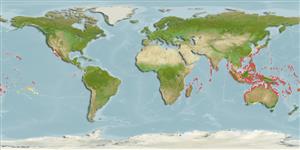
Indo-Pacific: East Africa to Samoa, north to southern Japan, south to New South Wales and Tonga.
Größe / Gewicht / Alter
Geschlechtsreife: Lm ? range ? - ? cm
Max length : 13.0 cm SL Männchen/unbestimmt; (Ref. 48637)
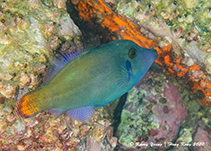
Rückenflossenstacheln (insgesamt) : 1 - 2; Rückenflossenweichstrahlen (insgesamt) : 29 - 34; Afterflossenstacheln: 0; Afterflossenweichstrahlen: 26 - 30. Body and head color variable. Blackish to dark bluish branchial blotch extending dorsally to level well above the lower margin of eye and may include ventrally the pectoral fin base and axil. Iris usually dark brown. Orange to red caudal fin soft dorsal and anal fins clear, orange or yellow with spots; pectorals clear. Scale spinulation at midbody closely packed. Male scale ridge rugosities develop at about 80 mm SL developed. Strong first dorsal spine. Large pelvic fin rudiment narrowly attached to posterior margin of ventral flap.
Body shape (shape guide): short and / or deep; Cross section: compressed.
Occurs in shallow lagoons and seaward reefs to a depth of about 15 m; common in coral-rich areas. Secretive species (Ref. 9710, 48637) among rocks, sponges or in crevices on the bases of large coral formations. Adults usually form pairs but often only one is observed while the other one is hiding (Ref. 48637).
Lebenszyklus und Paarungsverhalten
Geschlechtsreife | Fortpflanzung | Ablaichen | Eier | Fruchtbarkeit | Larven
Hutchins, J.B., 1986. Review of the monacanthid fish genus Pervagor, with descriptions of two new species. Indo-Pac. Fish. (12):35 p. (Ref. 527)
IUCN Rote Liste Status (Ref. 130435: Version 2025-2 (Global))
Bedrohung für Menschen
Harmless
Nutzung durch Menschen
Tools
Zusatzinformationen
Download XML
Internet Quellen
Schätzungen auf der Grundlage von Modellen
Bevorzugte Temperatur (Ref.
123201): 23.7 - 29.2, mean 28.1 °C (based on 2532 cells).
Phylogenetischer Diversitätsindex (Ref.
82804): PD
50 = 0.5039 [Uniqueness, from 0.5 = low to 2.0 = high].
Bayesian length-weight: a=0.01950 (0.01114 - 0.03412), b=2.93 (2.78 - 3.08), in cm total length, based on LWR estimates for this species & (Sub)family-body (Ref.
93245).
Trophische Ebene (Ref.
69278): 2.9 ±0.4 se; based on size and trophs of closest relatives
Widerstandsfähigkeit (Ref.
120179): hoch, Verdopplung der Population dauert weniger als 15 Monate. (Preliminary K or Fecundity.).
Anfälligkeit der Fischerei (Ref.
59153): Low vulnerability (10 of 100).
🛈
Nährstoffe (Ref.
124155): Calcium = 77.8 [33.2, 197.0] mg/100g; Iron = 0.798 [0.360, 1.897] mg/100g; Protein = 17.9 [15.6, 20.1] %; Omega3 = 0.105 [0.049, 0.217] g/100g; Selenium = 25.1 [11.9, 58.5] μg/100g; VitaminA = 80.3 [22.1, 293.9] μg/100g; Zinc = 1.66 [1.06, 2.64] mg/100g (wet weight);