Umwelt: Milieu / Klimazone / Tiefenbereich / Verbreitungsgebiet
Ökologie
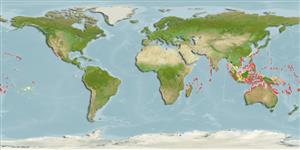
seewasser riff-verbunden; tiefenbereich 1 - 25 m (Ref. 9710). Tropical; 31°N - 23°S
Indo-West Pacific: Mauritius, Christmas Island, southern Japan, Marcus Islands, southern Taiwan, Australia, New Caledonia, Marshall Islands, Johnston Island, and Hawaiian Islands; distribution anti-equatorial. Recently reported from Tonga (Ref. 53797). Replaced by Pervagor marginalis in the Line and Marquesas Islands (Ref. 37816).
Größe / Gewicht / Alter
Geschlechtsreife: Lm ? range ? - ? cm
Max length : 13.0 cm TL Männchen/unbestimmt; (Ref. 30874)
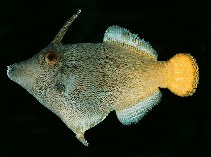
Rückenflossenstacheln (insgesamt) : 1 - 2; Rückenflossenweichstrahlen (insgesamt) : 31 - 35; Afterflossenstacheln: 0; Afterflossenweichstrahlen: 28 - 32. First dorsal spine strong. Posterior margin of ventral flap narrowly attached to large pelvic fin rudiment. Scale spinulation in midbody not closely packed. Body and head color variable; orange to brown iris; caudal fin yellow or orange; soft dorsal and anal fins clear to yellowish; spinous dorsal dark brown to brownish orange; pectorals clear. Numerous spots in head and body appear as dashes or lines Male scale ridge rugosities usually develop at about 60 mm SL.
Body shape (shape guide): short and / or deep; Cross section: compressed.
Inhabits clear lagoon and seaward reefs (Ref. 9710). Solitary among coral and rubble (Ref. 90102). Benthopelagic (Ref. 58302).
Lebenszyklus und Paarungsverhalten
Geschlechtsreife | Fortpflanzung | Ablaichen | Eier | Fruchtbarkeit | Larven
Hutchins, J.B., 1986. Review of the monacanthid fish genus Pervagor, with descriptions of two new species. Indo-Pac. Fish. (12):35 p. (Ref. 527)
IUCN Rote Liste Status (Ref. 130435: Version 2025-2 (Global))
Bedrohung für Menschen
Harmless
Nutzung durch Menschen
Tools
Zusatzinformationen
Download XML
Internet Quellen
Schätzungen auf der Grundlage von Modellen
Bevorzugte Temperatur (Ref.
123201): 25.2 - 29.3, mean 28.4 °C (based on 2416 cells).
Phylogenetischer Diversitätsindex (Ref.
82804): PD
50 = 0.5039 [Uniqueness, from 0.5 = low to 2.0 = high].
Bayesian length-weight: a=0.01905 (0.00905 - 0.04012), b=2.93 (2.75 - 3.11), in cm total length, based on LWR estimates for this (Sub)family-body shape (Ref.
93245).
Trophische Ebene (Ref.
69278): 2.9 ±0.4 se; based on size and trophs of closest relatives
Widerstandsfähigkeit (Ref.
120179): hoch, Verdopplung der Population dauert weniger als 15 Monate. (Preliminary K or Fecundity.).
Anfälligkeit der Fischerei (Ref.
59153): Low vulnerability (10 of 100).
🛈
Nährstoffe (Ref.
124155): Calcium = 81.4 [34.6, 206.7] mg/100g; Iron = 0.842 [0.379, 1.975] mg/100g; Protein = 17.9 [15.7, 20.1] %; Omega3 = 0.108 [0.050, 0.226] g/100g; Selenium = 27.4 [13.1, 63.0] μg/100g; VitaminA = 70.8 [19.7, 262.7] μg/100g; Zinc = 1.65 [1.06, 2.63] mg/100g (wet weight);