>
Eupercaria/misc (Various families in series Eupercaria) >
Labridae (Wrasses) > Scarinae
Etymology: Calotomus: Greek, kalos, kallos = beautiful + Greek, tomos = section, cut (Ref. 45335).
Umwelt: Milieu / Klimazone / Tiefenbereich / Verbreitungsgebiet
Ökologie
seewasser riff-verbunden; tiefenbereich 12 - 170 m (Ref. 525). Tropical
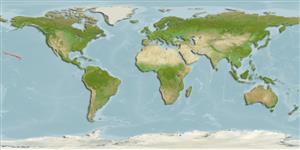
Pacific Ocean: Midway and Hawaiian islands.
Größe / Gewicht / Alter
Geschlechtsreife: Lm ? range ? - ? cm
Max length : 33.0 cm TL Männchen/unbestimmt; (Ref. 9710)
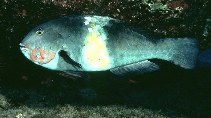
Rückenflossenstacheln (insgesamt) : 9; Rückenflossenweichstrahlen (insgesamt) : 10; Afterflossenstacheln: 3; Afterflossenweichstrahlen: 9; Wirbelzahl: 25. When fresh, reddish brown to brown dorsally, reddish to almost white ventrally; irregular fine whitish marks on scales. Head with white speckling; a reddish transverse band on chin, followed by a diffuse white band; reddish iris. Whitish pectoral fins, base reddish brown; 3 narrow irregular brownish red stripes on whitish pelvic fins. Pungent dorsal spines; rounded caudal fin at all sizes. Skin dark around anus, almost black. Lateral line interrupted.
Body shape (shape guide): short and / or deep; Cross section: compressed.
Occurs in areas of coral rock with coral or rubble, from the lower surge zone to at least 10 m (Ref. 9710). Benthopelagic (Ref. 58302). Protogynous (Ref. 55080).
Lebenszyklus und Paarungsverhalten
Geschlechtsreife | Fortpflanzung | Ablaichen | Eier | Fruchtbarkeit | Larven
Pair spawnings involved an initial- and a terminal-phase fish; group spawnings involve several of both. Investigations strongly suggest that the species is gonochoristic.
Bruce, R.W. and J.E. Randall, 1985. A revision of the Indo-West Pacific parrotfish genera Calotomus and Leptoscarus (Scaridae: Sparisomatinae). Indo-Pac. Fish. (5):32 p. (Ref. 525)
IUCN Rote Liste Status (Ref. 130435: Version 2025-2 (Global))
Bedrohung für Menschen
Harmless
Nutzung durch Menschen
Fischereien: kommerziell; Aquarium: Kommerziell
Tools
Zusatzinformationen
Download XML
Internet Quellen
Schätzungen auf der Grundlage von Modellen
Bevorzugte Temperatur (Ref.
123201): 8.9 - 21.7, mean 13.5 °C (based on 11 cells).
Phylogenetischer Diversitätsindex (Ref.
82804): PD
50 = 0.5312 [Uniqueness, from 0.5 = low to 2.0 = high].
Bayesian length-weight: a=0.02089 (0.00882 - 0.04947), b=2.99 (2.78 - 3.20), in cm total length, based on LWR estimates for this (Sub)family-body shape (Ref.
93245).
Widerstandsfähigkeit (Ref.
120179): mittel, Verdopplung der Population dauert 1,4 - 4,4 Jahre. (Preliminary K or Fecundity.).
Anfälligkeit der Fischerei (Ref.
59153): Low vulnerability (23 of 100).
🛈
Nährstoffe (Ref.
124155): Calcium = 36.1 [13.3, 97.9] mg/100g; Iron = 0.624 [0.246, 1.542] mg/100g; Protein = 18 [16, 20] %; Omega3 = 0.0728 [, ] g/100g; Selenium = 20.2 [6.3, 62.8] μg/100g; VitaminA = 33 [7, 140] μg/100g; Zinc = 1.82 [0.86, 3.26] mg/100g (wet weight);