>
Eupercaria/misc (Various families in series Eupercaria) >
Labridae (Wrasses) > Scarinae
Etymology: Calotomus: Greek, kalos, kallos = beautiful + Greek, tomos = section, cut (Ref. 45335).
More on authors: Quoy & Gaimard.
Environnement : milieu / zone climatique / profondeur / gamme de distribution
Écologie
marin récifal; profondeur 1 - 72 m (Ref. 86942). Tropical; 30°N - 30°S
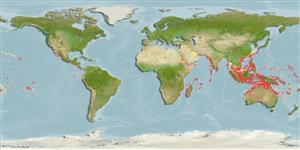
Indo-West Pacific: Kenya to at least Delagoa Bay in Mozambique, and east to the Marshall and Tonga Islands. Presence in Somalia to be confirmed (Ref. 30573).
Longueur à la première maturité / Taille / Poids / Âge
Maturité: Lm 10.5 range ? - ? cm
Max length : 30.0 cm TL mâle / non sexé; (Ref. 48636)
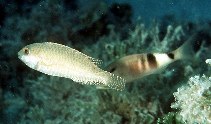
Épines dorsales (Total) : 9; Rayons mous dorsaux (Total) : 10; Épines anales: 3; Rayons mous anaux: 9; Vertèbres: 25. General body color when fresh is greenish brown with scales finely flecked with pale; shade of white ventrally (belly sometimes dull rose or yellowish). Across the chin, 2 irregular dull reddish bars interspaced by white or yellow; upper opercular margin with a diffused dark spot. Hyaline pectorals with a yellowish flush; pelvic fins hyaline except for numerous small white spots and some reddish blotches. Flexible dorsal spines. Area circumscribed by pectoral fin unspotted. Lateral line interrupted (scales usually 19 + 7, occasionally 19 + 6).
Body shape (shape guide): fusiform / normal; Cross section: compressed.
Found in coastal bays and deep lagoons (Ref. 48636). Inhabits seagrass beds or dense beds of algae. Well-camouflaged and easily overlooked (Ref. 48636). Feeds on these or the associated epiphytes. Caught nets and other types of artisanal gear.
Cycle de vie et comportement reproducteur
Maturité | Reproduction | Frai | Œufs | Fécondité | Larves
Spawning at Aldabra occurs above grassflats on falling tides; protogynous hermaphroditism with both primary & secondary males occurring in the atoll's population has also been reported (Ref. 1875).
Bruce, R.W. and J.E. Randall, 1985. A revision of the Indo-West Pacific parrotfish genera Calotomus and Leptoscarus (Scaridae: Sparisomatinae). Indo-Pac. Fish. (5):32 p. (Ref. 525)
Statut dans la liste rouge de l'IUCN (Ref. 130435: Version 2025-2 (Global))
Menace pour l'homme
Harmless
Utilisations par l'homme
Pêcheries: commercial; Aquarium: Commercial
Outils
Articles particuliers
Télécharger en XML
Sources Internet
Estimations basées sur des modèles
Température préférée (Réf.
123201): 24.5 - 28.9, mean 27.6 °C (based on 838 cells).
Indice de diversité phylogénétique (Réf.
82804): PD
50 = 0.5312 [Uniqueness, from 0.5 = low to 2.0 = high].
Bayesian length-weight: a=0.01318 (0.00821 - 0.02117), b=3.10 (2.97 - 3.23), in cm total length, based on LWR estimates for this species & (Sub)family-body (Ref.
93245).
Niveau trophique (Réf.
69278): 2.0 ±0.00 se; based on food items.
Generation time: 1.2 ( na - na) years. Estimated as median ln(3)/K based on 1
growth studies.
Résilience (Réf.
120179): Haut, temps minimum de doublement de population inférieur à 15 mois (K=1.00).
Vulnérabilité de la pêche (Ref.
59153): Low vulnerability (18 of 100).
🛈
Nutriments (Ref.
124155): Calcium = 42.7 [22.0, 141.1] mg/100g; Iron = 0.75 [0.32, 1.77] mg/100g; Protein = 18.5 [16.5, 20.3] %; Omega3 = 0.0887 [, ] g/100g; Selenium = 18.2 [6.1, 48.0] μg/100g; VitaminA = 40.4 [12.3, 139.7] μg/100g; Zinc = 2.35 [1.17, 4.07] mg/100g (wet weight);