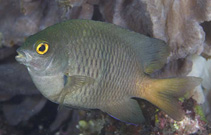
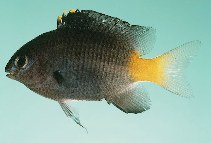
Klassifizierung / Names
Namen | Synonyme | Catalog of Fishes(Gattung, Arten) | ITIS | CoL | WoRMS | Cloffa
>
Ovalentaria/misc (Various families in series Ovalentaria) >
Pomacentridae (Damselfishes) > Microspathodontinae
Etymology: Plectroglyphidodon: Greek,plektron = anything to strike with, spur + Greek, glyphis = carved + Greek, odous = teeth (Ref. 45335).
More on author: Ogilby.
Umwelt: Milieu / Klimazone / Tiefenbereich / Verbreitungsgebiet
Ökologie
seewasser riff-verbunden; standorttreu (Ref. 52884); tiefenbereich 0 - 30 m (Ref. 9710), usually 1 - 5 m (Ref. 9710). Tropical; 40°N - 35°S, 31°E - 109°W
Indo-Pacific: East Africa to eastern Oceania, including the Hawaiian and Easter islands, north to the Ryukyu Islands, south to Australia and the New Zealand.
Größe / Gewicht / Alter
Geschlechtsreife: Lm ? range ? - ? cm
Max length : 16.5 cm NG Männchen/unbestimmt; (Ref. 89467)
Rückenflossenstacheln (insgesamt) : 13; Rückenflossenweichstrahlen (insgesamt) : 15 - 17; Afterflossenstacheln: 2; Afterflossenweichstrahlen: 12 - 14.
Body shape (shape guide): fusiform / normal; Cross section: oval.
Adults inhabit rocky and coral reefs exposed to mild to moderate surge (Ref. 9710). Benthopelagic (Ref. 58302). They occur solitary among boulders (Ref. 48636). Territorial in areas where filamentous algae cover rocks and dead coral (Ref. 9710). Monogamous (Ref. 52884). Oviparous, distinct pairing during breeding (Ref. 205). Eggs are demersal and adhere to the substrate (Ref. 205). Males guard and aerate the eggs (Ref. 205). Minimum depth reported taken from Ref. 128797.
Lebenszyklus und Paarungsverhalten
Geschlechtsreife | Fortpflanzung | Ablaichen | Eier | Fruchtbarkeit | Larven
Oviparous, distinct pairing during breeding (Ref. 205). Monogamous mating is observed as both facultative and social (Ref. 52884). Eggs are demersal and adhere to the substrate (Ref. 205). Males guard and aerate the eggs (Ref. 205).
Allen, G.R. and A.R. Emery, 1985. A review of the Pomacentrid fishes of the genus Stegastes from the Indo-Pacific, with descriptions of two new species. Indo-Pac. Fish. (3):31. (Ref. 510)
IUCN Rote Liste Status (Ref. 130435: Version 2025-2 (Global))
Bedrohung für Menschen
Harmless
Nutzung durch Menschen
Fischereien: weniger kommerziell
Tools
Zusatzinformationen
Download XML
Internet Quellen
Schätzungen auf der Grundlage von Modellen
Bevorzugte Temperatur (Ref.
123201): 18.5 - 29.2, mean 27.9 °C (based on 2466 cells).
Phylogenetischer Diversitätsindex (Ref.
82804): PD
50 = 0.5000 [Uniqueness, from 0.5 = low to 2.0 = high].
Bayesian length-weight: a=0.01259 (0.00497 - 0.03190), b=3.04 (2.82 - 3.26), in cm total length, based on LWR estimates for this (Sub)family-body shape (Ref.
93245).
Trophische Ebene (Ref.
69278): 2.2 ±0.1 se; based on diet studies.
Widerstandsfähigkeit (Ref.
120179): hoch, Verdopplung der Population dauert weniger als 15 Monate. (Preliminary K or Fecundity.).
Anfälligkeit der Fischerei (Ref.
59153): Low vulnerability (10 of 100).
🛈
Nährstoffe (Ref.
124155): Calcium = 95.7 [53.3, 149.0] mg/100g; Iron = 0.781 [0.493, 1.216] mg/100g; Protein = 18.5 [17.4, 19.5] %; Omega3 = 0.131 [0.086, 0.201] g/100g; Selenium = 26.3 [15.8, 47.3] μg/100g; VitaminA = 94.6 [30.3, 289.3] μg/100g; Zinc = 2.03 [1.43, 2.78] mg/100g (wet weight);