sub class Elasmobranchii (ฉลามและกระเบน) (sharks and rays) >
Rajiformes (Skates and rays) >
Rajidae (Skates)
Etymology: Raja: Latin, raja, -ae = a sting ray (Raja sp.) (Ref. 45335).
Eponymy: Colonel George Montagu (1751–1815) was a soldier and natural history writer. [...] (Ref. 128868), visit book page.
More on author: Fowler.
สิ่งแวดล้อม : สิ่งแวดล้อม / เขตภูมิอากาศ / ระดับความลึก / ระยะการกระจายสินค้า
นิเวศวิทยา
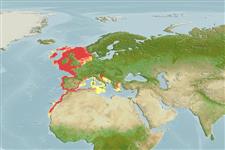
เกี่ยวกับทะเล,น้ำเค็ม สัตว์น้ำหน้าดิน; ระดับความลึก 8 - 530 m (Ref. 88171). Temperate; 61°N - 16°N, 18°W - 25°E
Eastern Atlantic: Shetlands, southern North Sea and the western Baltic to Mauritania, including the western part of the Mediterranean (to Tunisia and western Greece).
ความยาวเมื่อครบกำหนดครั้งแรก / ขนาด / น้ำหนัก / อายุ
วัยเจริญพันธุ์: Lm 61.0 range ? - ? cm
Max length : 102 cm TL เพศผู้/กระเทย; (Ref. 6014); common length : 50.0 cm TL เพศผู้/กระเทย; (Ref. 3261); อายุสูงสุดที่ได้รายงาน: 18 ปี (Ref. 88187)
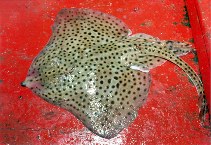
เงี่ยงครีบหลัง (รวม) : 0; เงี่ยงครีบก้น: 0. Sub-rhomboid in shape with a short rostrum and rounded wing-tips. Upper surface almost smooth in young, but prickly in large specimens, except for bare centers of pectoral fins and hind part of disc, underside nearly smooth; orbital thorns separate, a regular row of 20-50 usually persistent thorns from nape to first dorsal fin; with 1-2 thorns between dorsal fins; 2 equal-sized dorsal fins at end of tail. Brownish dorsally with numerous small dark spots which do not reach the margin of the disc, frequently with a concentration of dark spots forming a ring around a pale centre on hind part of each pectoral fin, underside white (Ref. 3167).
Body shape (shape guide): other; Cross section: flattened.
Found mainly along the continental shelf (Ref. 3167). Depth range from 8-283 m in the northeast Atlantic (Ref. 82399), in the southern part of its range it occurs down to 530 m (Ref. 78469, 89037), but most common between 20-120 m (Ref. 88187). Prefers habitats with sand or mud bottoms (Ref. 78469). Juveniles usually found in shallow sandy inshore areas, adults utilize more offshore sand or sand-gravel habitats (Ref. 82399, 89038). Species buries itself to avoid predation and ambush potential prey. Feeds mainly on crustaceans (Ref. 3167) with prey size increasing as it grows (Ref. 88171), also preys on benthic worms, cephalopods and small fishes (Ref. 41849, 58137). Most individuals attain a length of 40-60 cm (Ref. 3261). Oviparous. Young may tend to follow large objects, such as their mother (Ref. 205). Detects weak electric fields generated by other organisms and generate its own weak electric fields (Ref. 10311).
Oviparous. Distinct pairing with embrace. Paired eggs are laid during summer (Ref. 3167). Eggs are oblong capsules with stiff pointed horns at the corners deposited in sandy or muddy flats (Ref. 205). Egg capsules are 5.3-7.8 cm long and 3.0-5.0 cm wide (Ref. 41250). Fully formed pups hatch after about 5-6 months and are about 11-12 cm in length (Ref. 78469, 88187).
McEachran, J.D. and K.A. Dunn, 1998. Phylogenetic analysis of skates, a morphologically conservative clade of elasmobranchs (Chondrichthyes: Rajidae). Copeia 1998(2):271-290. (Ref. 27314)
สถานะบัญชีแดงของ IUCN (Ref. 130435: Version 2025-2 (Global))
ภัยคุกคามต่อมนุษย์
Harmless
การใช้ของมนุษย์
การประมง: มีการค้าเพียงเล็กน้อย
เครื่องมือ
รายงานพิเศษ
ดาวน์โหลด XML
แหล่งที่มาจากอินเตอร์เน็ต
การประมาณค่าตามแบบจำลอง
อุณหภูมิที่ต้องการ (อ้างอิง
123201): 7 - 16, mean 9.9 °C (based on 418 cells).
ดัชนีความหลากหลายทางวิวัฒนาการ (อ้างอิง
82804): PD
50 = 0.5000 [Uniqueness, from 0.5 = low to 2.0 = high].
Bayesian length-weight: a=0.00251 (0.00202 - 0.00312), b=3.25 (3.21 - 3.29), in cm total length, based on LWR estimates for this species (Ref.
93245).
ระดับชั้นอาหาร (อ้างอิง
69278): 3.9 ±0.2 se; based on diet studies.
ความสามารถในการกลับคืนสู่ปกติ (อ้างอิง
120179): ต่ำ, เวลาต่ำสุดที่จะทำให้ประชากรเพิ่มขึ้นเป็น 2 เท่าใช้เวลา 4.5 - 14 ปี (K=0.18-0.21; tm=8; tmax=14; Fec=24).
Prior r = 0.40, 95% CL = 0.27 - 0.61, Based on 1 full stock assessment.
ความเสี่ยงต่อการตกปลา (Ref.
59153): High vulnerability (58 of 100).
🛈
ความเสี่ยงต่อสภาพภูมิอากาศ (Ref.
125649): High to very high vulnerability (67 of 100).
🛈
สารอาหาร (Ref.
124155): Calcium = 5.91 [0.83, 102.85] mg/100g; Iron = 0.244 [0.023, 2.859] mg/100g; Protein = 16.8 [14.0, 19.1] %; Omega3 = 1 [0, 2] g/100g; Selenium = 14.6 [3.0, 72.2] μg/100g; VitaminA = 6.24 [0.46, 70.18] μg/100g; Zinc = 0.34 [0.02, 3.74] mg/100g (wet weight);