>
Eupercaria/misc (Various families in series Eupercaria) >
Sciaenidae (Drums or croakers)
Etymology: Pseudotolithus: Greek, pseudes = false + greek, otos = ear + Greek, lithos = stone (Ref. 45335).
More on author: Valenciennes.
Entorno: milieu / zona climática / rango de profundidad / gama de distribución
Ecología
marino demersal; rango de profundidad 0 - 70 m (Ref. 3593). Tropical; 27°N - 22°S
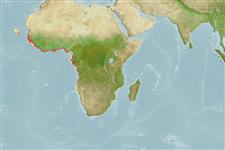
Eastern Atlantic: west coast of Africa, from Morocco to Angola, but rare north of Senegal (Ref. 57396). Also reported from Namibia (Ref. 3593).
Longitud en la primera madurez / Tamaño / Peso / Edad
Madurez: Lm 35.0, range 28 - ? cm
Max length : 114 cm TL macho / no sexado; (Ref. 40637); common length : 50.0 cm TL macho / no sexado; (Ref. 3593); peso máximo publicado: 12.0 kg (Ref. 40637)
Espinas dorsales (total) : 11; Radios blandos dorsales (total) : 28 - 33; Espinas anales: 2; Radios blandos anales: 7. Diagnosis: large fish, elongate and compressed (Ref. 57396). Eyes small (Ref. 57396, 81656), 5.7-6.4 times in HL, but this character is difficult to use for identification because of allometry (Ref. 81656). Snout short; mouth large and oblique; lower jaw prominent; both jaws with bands of villiform teeth (upper jaw with teeth in outer row larger and sharper, including a pair of large median canines, lower jaw with teeth in inner row larger and sharper); 6 pores on chin and 5 marginal pores on snout (Ref. 57396). 9-12/1/4-6 (total 12-18) gill rakers on 1st gill arch; gill rakers short, about as long as gill filament at angle between lower and upper part of gill arch (Ref. 81656). Dorsal fin long and deeply notched (Ref. 57396), with 10 spines in the first part and 1 spine and 28-33 soft fin rays in second part (Ref. 81656). Second anal fin spine rather short and slender, attaining about 2/3 of the length of 1st soft ray and comprised over 3 times in head length; caudal fin pointed; scales weakly ctenoid on body, cycloid on snout and suborbital region; lateral line extending to end of caudal fin; swim bladder carrot-shaped, its front end with a pair of appendices subdividing into an anterior group of short branches and 2 posterior groups of long, slender tubules, one of them ventral, the other dorso-lateral and longer, bordering the bladder throughout its length (Ref. 57396).
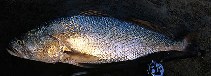
Coloration: silvery grey, with series of small dark spots following scale rows, oblique on anterior part of back and sides, horizontal posteriorly; black spot at tip of spinous part of dorsal fin; pelvics and anal fin more or less dark yellowish; caudal fin dark; inside of gill cover black (Ref. 57396).
Body shape (shape guide): fusiform / normal; Cross section: compressed.
Found in coastal waters over muddy, sandy or rocky bottoms. Smaller individuals found in shallow waters, but rarely entering estuaries. Feed on fish (fry of the long-finned herring in Ref. 114789), shrimps and crabs (Ref. 28587). Spawn from November to March in waters of 22 to 25°C in the Gulf of Guinea. Most economically important demersal fish in West African waters.
Ciclo vital y comportamiento de apareamiento
Madurez | Reproducción | Puesta | Huevos | Fecundidad | Larva
Chao, L.N. and E. Trewavas, 1990. Sciaenidae. p. 813-826. In J.C. Quero, J.C. Hureau, C. Karrer, A. Post and L. Saldanha (eds.) Check-list of the fishes the eastern tropical Atlantic (CLOFETA). JNICT, Lisbon; SEI, Paris; and UNESCO, Paris. Vol. 2. (Ref. 3593)
Situación en la Lista Roja de la UICN (Ref. 130435: Version 2025-2 (Global))
Amenaza para el ser humano
Harmless
Usos humanos
Pesquerías: escaso valor comercial; pesca deportiva: si
Herramientas
Informes especiales
Descargar XML
Fuentes de Internet
Estimaciones basadas en modelos
Temperatura preferida (Referencia
123201): 22.7 - 27.9, mean 26.3 °C (based on 82 cells).
Índice de diversidad filogenética (Referencia
82804): PD
50 = 0.5156 [Uniqueness, from 0.5 = low to 2.0 = high].
Bayesian length-weight: a=0.00724 (0.00431 - 0.01217), b=3.06 (2.92 - 3.20), in cm total length, based on LWR estimates for this species & (Sub)family-body (Ref.
93245).
Nivel trófico (Referencia
69278): 3.8 ±0.71 se; based on food items.
Generation time: 4.2 ( na - na) years. Estimated as median ln(3)/K based on 2
growth studies.
Resiliencia (Referencia
120179): Medio, población duplicada en un tiempo mínimo de 1.4-4.4 años (K=0.33; tmax=8; assuming tm=2).
Prior r = 0.31, 95% CL = 0.20 - 0.46, Based on 1 full stock assessment.
Vulnerabilidad pesquera (Ref.
59153): Moderate vulnerability (40 of 100).
🛈
Vulnerabilidad climática (Ref.
125649): Very high vulnerability (83 of 100).
🛈
Nutrientes (Ref.
124155): Calcium = 74.4 [44.2, 142.6] mg/100g; Iron = 0.878 [0.439, 1.545] mg/100g; Protein = 19.2 [18.0, 20.3] %; Omega3 = 0.193 [0.107, 0.321] g/100g; Selenium = 71.6 [39.2, 141.9] μg/100g; VitaminA = 11.8 [4.2, 34.3] μg/100g; Zinc = 0.805 [0.582, 1.163] mg/100g (wet weight);