Taxonomic Remarks
Hybridizes with Parophrys vetulus - the hybrid, called Inopsetta ischyra, may be found from the Bering Sea to San Francisco, California, USA (ref. 6885). Also hybridizes with Kareius bicoloratus (Ref. 27547).
Ambiente: milieu / zona climatica / distribuzione batimetrica / gamma di distribuzione
Ecologia
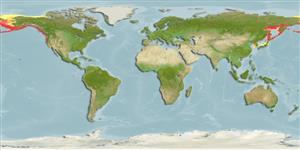
marino; acqua dolce; salmastro demersale; catadromo (Ref. 126106); distribuzione batimetrica 0 - 375 m (Ref. 6793). Polar; 73°N - 33°N, 124°E - 119°W
Northern Pacific, from the Yellow Sea along coasts of Korean Peninsula, Russian Far East, and Japanese Arch. to the Arctic, including Chukchi and Beaufort seas, extending to the south through the Bering Sea to California.
Lunghezza alla prima maturità / Dimensione / Peso / Età
Maturità: Lm ?, range 35 - ? cm
Max length : 91.0 cm TL maschio/sesso non determinato; (Ref. 2850); common length : 57.5 cm TL maschio/sesso non determinato; (Ref. 12193); peso massimo pubblicato: 9.1 kg (Ref. 2850); Età massima riportata: 42 anni (Ref. 117245)
Breve descrizione
Chiavi di identificazione | Morfologia | Morfometria
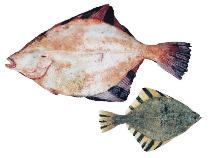
Spine dorsali (totale) : 0; Raggi dorsali molli (totale) : 52 - 66; Spine anali: 1; Raggi anali molli: 38 - 47; Vertebre: 34 - 37. Distinguished by the presence of both eyes on the same side of the head, dorsal and anal fins that are marked with dark and light (white to orange) bars, and especially, by the stellate, bony tubercles scattered over its body (Ref. 27547). Dorsal originates over middle of upper eye; anal with a sharp, forward pointing spine (often buried in skin) before first ray; pectorals are bluntly pointed; caudal slightly rounded (Ref. 27547). Eyed side dark brown to nearly black, sometimes with indefinite blotchings (Alaskans specimens sometimes with a greenish tinge); blind side white to creamy; dorsal fin with 4 to 7 dark bars with white to orange spaces between; anal fin with 4 to 6 such bars; caudal fin with 3 or 4 dark longitudinal bars on its posterior part; in rare cases, the blind side may be partly or completely colored like the eyed side, or white may be present on the eyed side, creating a piebald effect (Ref. 27547, 28897, 28898).
Body shape (shape guide): short and / or deep.
Found inshore, often in very shallow water and in estuaries during the summer; moving into deeper water in the winter (Ref. 27547). However, they may occur in deep water throughout the year (Ref. 27547). They do not venture into water of high salinities (Ref. 28899). Young and adults move up rivers, as much as 120 km (Ref. 27547). Benthic (Ref. 58426). They feed on crustaceans, worms, small mollusks, brittle stars, and small fishes (Ref. 6885). Important game fish (Ref. 2850). Utilized fresh and frozen; eaten steamed, fried, boiled, microwaved, and baked (Ref. 9988).
Onset of metamorphosis occurs at 10.5 mm. First settlement of young is in shallow silty-sandy substrates, usually in estuaries (Ref. 117245).
Vinnikov, K.A., R.C. Thomson and T.A. Munroe, 2018. Revised classification of the righteye flounders (Teleostei: Pleuronectidae) based on multilocus phylogeny with complete taxon sampling. Molecular phylogenetics and evolution, 125:147-162. (Ref. 122998)
Stato della Lista Rossa IUCN (Ref. 130435: Version 2025-2 (Global))
Minaccia per l'uomo
Harmless
Usi umani
Pesca: scarso interesse commerciale; Pesce da pesca sportiva: si
Strumenti
Rapporti speciali
Scarica XML
Fonti Internet
Stime basate su modelli
Temperatura preferita (Fonte Biblio.
123201): 0.2 - 8.3, mean 3.2 °C (based on 669 cells).
Indice di diversità filogenetica (Fonte Biblio.
82804): PD
50 = 0.5625 [Uniqueness, from 0.5 = low to 2.0 = high].
Bayesian length-weight: a=0.00813 (0.00710 - 0.00931), b=3.09 (3.05 - 3.13), in cm total length, based on LWR estimates for this species (Ref.
93245).
Livello trofico (Fonte Biblio.
69278): 3.6 ±0.1 se; based on diet studies.
Generation time: 5.7 ( na - na) years. Estimated as median ln(3)/K based on 1
growth studies.
Resilienza (Fonte Biblio.
120179): Molto basso, tempo minimo di raddoppiamento della popolazione più di 14 anni (tm=2-3; tmax=42).
Vulnerabilità della pesca (Ref.
59153): Moderate to high vulnerability (51 of 100).
🛈
Vulnerabilità climatica (Ref.
125649): High vulnerability (61 of 100).
🛈
Nutrienti (Ref.
124155): Calcium = 19.3 [7.6, 34.8] mg/100g; Iron = 0.295 [0.124, 0.633] mg/100g; Protein = 17.3 [15.2, 19.3] %; Omega3 = 0.192 [0.086, 0.415] g/100g; Selenium = 19.4 [7.6, 49.8] μg/100g; VitaminA = 4.35 [0.71, 27.54] μg/100g; Zinc = 0.332 [0.214, 0.514] mg/100g (wet weight); based on
nutrient studies.