>
Eupercaria/misc (Various families in series Eupercaria) >
Sciaenidae (Drums or croakers)
Etymology: Paralonchurus: Greek, para = the side of + Greek, logchos = lance + Greek, oura = tail (Ref. 45335).
More on author: Steindachner.
Umwelt: Milieu / Klimazone / Tiefenbereich / Verbreitungsgebiet
Ökologie
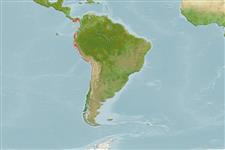
seewasser demersal; tiefenbereich 10 - ? m. Tropical; 9°N - 20°S, 82°W - 70°W (Ref. 112843)
Eastern Pacific: Panama to northern Chile.
Länge bei der ersten Reifung / Größe / Gewicht / Alter
Geschlechtsreife: Lm ?, range 24 - ? cm
Max length : 51.0 cm TL Männchen/unbestimmt; (Ref. 55763); common length : 30.0 cm TL Männchen/unbestimmt; (Ref. 55763)
Kurzbeschreibung
Bestimmungsschlüssel | Morphologie | Morphometrie
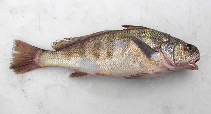
Body elongate, moderately compressed, with an arched dorsal profile; snout prominent; mouth small and inferior; lower jaw enclosed by upper; chin with 5 pores and 12 to 15 pairs of small barbels; edge of preopercle smooth; lower branch of first gill arch with 10 to 14 gill rakers; body uniformly dark and silvery; flanks with 7 or 8 indistinct bars; fins dark (Ref. 55763).
Body shape (shape guide): fusiform / normal; Cross section: other (see Diagnosi.
Found along sandy coasts and in bays (Ref. 9118). Feeds mainly on worms and other benthic invertebrates (Ref. 9118). Common in local markets (Ref. 9118).
Chao, L.N., 1995. Sciaenidae. Corvinas, barbiches, bombaches, corvinatas, corvinetas, corvinillas, lambes, pescadillas, roncachos, verrugatos. p. 1427-1518. In W. Fischer, F. Krupp, W. Schneider, C. Sommer, K.E. Carpenter and V. Niem (eds.) Guia FAO para identificacion de especies para los fines de la pesca. Pacifico Centro-oriental. 3 volumes. 1813 p. (Ref. 9118)
IUCN Rote Liste Status (Ref. 130435: Version 2025-2 (Global))
Bedrohung für Menschen
Harmless
Nutzung durch Menschen
Fischereien: kommerziell; Aquarium: Kommerziell
Tools
Zusatzinformationen
Download XML
Internet Quellen
Schätzungen auf der Grundlage von Modellen
Bevorzugte Temperatur (Ref.
123201): 17 - 22.8, mean 20.4 °C (based on 14 cells).
Phylogenetischer Diversitätsindex (Ref.
82804): PD
50 = 0.5156 [Uniqueness, from 0.5 = low to 2.0 = high].
Bayesian length-weight: a=0.00776 (0.00483 - 0.01247), b=3.11 (2.98 - 3.24), in cm total length, based on LWR estimates for this species & (Sub)family-body (Ref.
93245).
Trophische Ebene (Ref.
69278): 2.2 ±0.1 se; based on diet studies.
Widerstandsfähigkeit (Ref.
120179): mittel, Verdopplung der Population dauert 1,4 - 4,4 Jahre. (Assuming tm=2).
Anfälligkeit der Fischerei (Ref.
59153): Moderate vulnerability (40 of 100).
🛈
Klimaanfälligkeit (Ref.
125649): Very high vulnerability (80 of 100).
🛈
Nährstoffe (Ref.
124155): Calcium = 134 [77, 299] mg/100g; Iron = 1.13 [0.57, 2.08] mg/100g; Protein = 18.4 [17.1, 19.6] %; Omega3 = 0.175 [0.089, 0.309] g/100g; Selenium = 60 [31, 128] μg/100g; VitaminA = 14 [4, 47] μg/100g; Zinc = 1.42 [0.99, 2.12] mg/100g (wet weight);