>
Perciformes/Cottoidei (Sculpins) >
Agonidae (Poachers) > Brachyopsinae
Eponymy: Cygnus G Chesnon (dates unknown) published a rare book on the natural history of Normandy, France (1835), in which he proposed the name Occa (now = Somateria) for a genus of eider ducks. [...] (Ref. 128868), visit book page.
Environnement : milieu / zone climatique / profondeur / gamme de distribution
Écologie
marin démersal; profondeur 18 - 425 m (Ref. 6793). Temperate
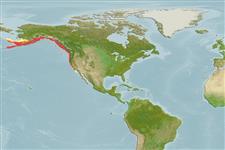
Northeast Pacific: Bristol Bay, Alaska to Unimak Island in the Aleutian chain and Point Montara, California, USA (Ref. 6793); extended to southeastern Bering Sea (Ref. 51659).
Taille / Poids / Âge
Maturité: Lm ? range ? - ? cm
Max length : 20.0 cm TL mâle / non sexé; (Ref. 2850)
Description synthétique
Clés d'identification | Morphologie | Morphométrie
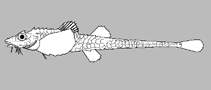
Épines dorsales (Total) : 8 - 9; Rayons mous dorsaux (Total) : 6 - 9; Épines anales: 0; Rayons mous anaux: 10 - 12; Vertèbres: 35 - 37. Dorsal fins touching or nearly so; caudal rounded; anal long based and rather low; pectorals broad, lower 4 to 6 rays thickened and not joined by membrane as far as their ends; pelvic fins reduced (in males, long pelvic fins reaching as far as the origin of the anal fin) (Ref. 6885). Dark gray or brown on upper surface, paler beneath, the line of demarcation very clear on head; some individuals with 6 or more dark saddle-shaped markings over back and extending on sides; dorsal fins with dark bands following free margins on fins; longitudinal dark coloring follows rays of caudal fin, especially at distal ends; rows of dark spots on rays of pectorals, and a bright orange spot in its center; dark spots on eyeballs more abundant on upper part (Ref. 6885).
Body shape (shape guide): elongated.
Found on soft bottoms (Ref. 2850).
Cycle de vie et comportement reproducteur
Maturité | Reproduction | Frai | Œufs | Fécondité | Larves
Eschmeyer, W.N., E.S. Herald and H. Hammann, 1983. A field guide to Pacific coast fishes of North America. Boston (MA, USA): Houghton Mifflin Company. xii+336 p. (Ref. 2850)
Statut dans la liste rouge de l'IUCN (Ref. 130435: Version 2025-2 (Global))
Menace pour l'homme
Harmless
Utilisations par l'homme
Outils
Articles particuliers
Télécharger en XML
Sources Internet
Estimations basées sur des modèles
Température préférée (Réf.
123201): 2.9 - 8.6, mean 5.3 °C (based on 283 cells).
Indice de diversité phylogénétique (Réf.
82804): PD
50 = 1.0000 [Uniqueness, from 0.5 = low to 2.0 = high].
Bayesian length-weight: a=0.00389 (0.00180 - 0.00842), b=3.12 (2.94 - 3.30), in cm total length, based on all LWR estimates for this body shape (Ref.
93245).
Niveau trophique (Réf.
69278): 3.2 ±0.3 se; based on size and trophs of closest relatives
Résilience (Réf.
120179): Milieu, temps minimum de doublement de population : 1,4 à 4,4 années (Preliminary K or Fecundity.).
Vulnérabilité de la pêche (Ref.
59153): Low vulnerability (10 of 100).
🛈