>
Perciformes/Cottoidei (Sculpins) >
Cottidae (Sculpins)
Etymology: Triglops: Greek, trigla, es = red mullet + greek, ops = appearance (Ref. 45335).
Eponymy: Dr Peter Christian Pingel (1793–1852) was a Danish geologist and Arctic scientist. [...] (Ref. 128868), visit book page.
Environnement : milieu / zone climatique / profondeur / gamme de distribution
Écologie
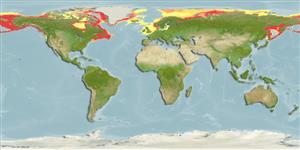
marin démersal; profondeur 0 - 930 m (Ref. 58496), usually 18 - 91 m (Ref. 2850). Temperate; 79°N - 41°N, 180°W - 180°E (Ref. 117245)
Arctic: Alaskan Beaufort Sea (Ref. 28503). North Pacific: Japan through the Aleutian chain and the Bering Sea to Washington, USA. North Atlantic: Cape Cod, USA to Greenland, Spitzbergen, and Denmark (Ref. 27436). Northwest Atlantic: Canada (Ref. 5951).
Taille / Poids / Âge
Maturité: Lm ? range ? - ? cm
Max length : 20.0 cm TL mâle / non sexé; (Ref. 7297); 20.2 cm SL (female); âge max. reporté: 6 années (Ref. 122394)
Description synthétique
Clés d'identification | Morphologie | Morphométrie
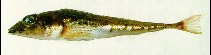
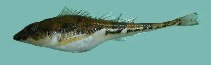
Épines dorsales (Total) : 10 - 11; Rayons mous dorsaux (Total) : 23 - 26; Épines anales: 0; Rayons mous anaux: 23 - 26. Caudal fin small. Lower 7-8 rays of pectoral fins moderately exserted but not especially thickened.
Body shape (shape guide): fusiform / normal.
Found on mud bottoms with some rocks (Ref. 4698). Maximum depth reported at 930 m (58426). Benthic to epibenthic (Ref. 58426). Feeds on small crustaceans, usually amphipods and mysids, rarely polychaetes and fishes (Ref. 4698).
Cycle de vie et comportement reproducteur
Maturité | Reproduction | Frai | Œufs | Fécondité | Larves
Pietsch, T.W., 1993. Systematics and distribution of cottid fishes of the genus Triglops Reinhardt (Teleostei: Scorpaeniformes). Zool. J. Linn. Soc. 109:335-393. (Ref. 7297)
Statut dans la liste rouge de l'IUCN (Ref. 130435: Version 2025-2 (Global))
Menace pour l'homme
Harmless
Utilisations par l'homme
Pêcheries: sans intérêt
Outils
Articles particuliers
Télécharger en XML
Sources Internet
Estimations basées sur des modèles
Température préférée (Réf.
123201): -1.6 - 6.7, mean 0.4 °C (based on 4342 cells).
Indice de diversité phylogénétique (Réf.
82804): PD
50 = 0.5010 [Uniqueness, from 0.5 = low to 2.0 = high].
Bayesian length-weight: a=0.00490 (0.00308 - 0.00780), b=3.08 (2.94 - 3.22), in cm total length, based on LWR estimates for this species & (Sub)family-body (Ref.
93245).
Niveau trophique (Réf.
69278): 3.4 ±0.3 se; based on diet studies.
Generation time: 5.8 ( na - na) years. Estimated as median ln(3)/K based on 1
growth studies.
Résilience (Réf.
120179): Milieu, temps minimum de doublement de population : 1,4 à 4,4 années (Preliminary K or Fecundity.).
Vulnérabilité de la pêche (Ref.
59153): Moderate vulnerability (42 of 100).
🛈