>
Perciformes/Cottoidei (Sculpins) >
Cottidae (Sculpins)
Etymology: Synchirus: Greek, syn, symphysis = grown together + Greek, cheir = hand (Ref. 45335); gilli: Named after Theodore Gill, U.S. ichthyologist (Ref. 6885).
Eponymy: Professor Theodore Nicholas Gill (1837–1914) was an American ichthyologist, malacologist, mammologist and librarian, a zoologist at George Washington University and associated with the Smithsonian Institution for more than half a century. [...] (Ref. 128868), visit book page.
More on author: Bean.
Environnement : milieu / zone climatique / profondeur / gamme de distribution
Écologie
marin démersal. Temperate; 59°N - 32°N
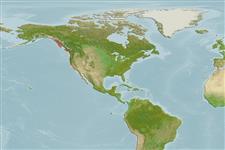
Eastern Pacific: Sitka, Alaska to San Miguel Island, southern California, USA.
Longueur à la première maturité / Taille / Poids / Âge
Maturité: Lm ?, range 5 - ? cm
Max length : 7.0 cm TL mâle / non sexé; (Ref. 2850)
Description synthétique
Clés d'identification | Morphologie | Morphométrie
Épines dorsales (Total) : 9 - 10; Rayons mous dorsaux (Total) : 20 - 21; Épines anales: 0; Rayons mous anaux: 20 - 21. Caudal fin rounded. Pelvic fins small.
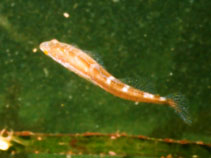
Found in bays, tide pools and among kelp (Ref. 2850). Previously thought as rare species, but relatively common in some areas, especially kelp beds (Ref. 2850). Feeds on small crustaceans (Ref. 6885). Can cling to bottoms or pilings with its pectoral and pelvic fins (Ref. 2850).
Cycle de vie et comportement reproducteur
Maturité | Reproduction | Frai | Œufs | Fécondité | Larves
Eschmeyer, W.N., E.S. Herald and H. Hammann, 1983. A field guide to Pacific coast fishes of North America. Boston (MA, USA): Houghton Mifflin Company. xii+336 p. (Ref. 2850)
Statut dans la liste rouge de l'IUCN (Ref. 130435: Version 2025-2 (Global))
Menace pour l'homme
Harmless
Utilisations par l'homme
Outils
Articles particuliers
Télécharger en XML
Sources Internet
Estimations basées sur des modèles
Température préférée (Réf.
123201): 6.4 - 12.8, mean 9.3 °C (based on 242 cells).
Indice de diversité phylogénétique (Réf.
82804): PD
50 = 1.0000 [Uniqueness, from 0.5 = low to 2.0 = high].
Bayesian length-weight: a=0.00603 (0.00290 - 0.01252), b=3.14 (2.96 - 3.32), in cm total length, based on LWR estimates for this (Sub)family-body shape (Ref.
93245).
Niveau trophique (Réf.
69278): 3.5 ±0.50 se; based on food items.
Résilience (Réf.
120179): Haut, temps minimum de doublement de population inférieur à 15 mois (Preliminary K or Fecundity.).
Vulnérabilité de la pêche (Ref.
59153): Low vulnerability (10 of 100).
🛈
Nutriments (Ref.
124155): Calcium = 154 [59, 376] mg/100g; Iron = 0.488 [0.222, 1.170] mg/100g; Protein = 17.1 [14.9, 19.3] %; Omega3 = 0.838 [0.328, 2.461] g/100g; Selenium = 12.3 [5.0, 33.6] μg/100g; VitaminA = 38.6 [9.2, 144.8] μg/100g; Zinc = 0.969 [0.601, 1.751] mg/100g (wet weight);