>
Eupercaria/misc (Various families in series Eupercaria) >
Sciaenidae (Drums or croakers)
Etymology: Umbrina: Latin, umbra, -ae = shadow, in the sense of phantom; due to its quick movements (Ref. 45335).
Eponymy: Don Sabas Canosa was a ‘preparater’ and later conservator at the National Museum of Montevideo, Uruguay. He was responsible for taxidermy and other forms of preservation of specimens. He also collected for the museum. (Ref. 128868), visit book page.
Taxonomic Remarks
Berg, C.
Umwelt: Milieu / Klimazone / Tiefenbereich / Verbreitungsgebiet
Ökologie
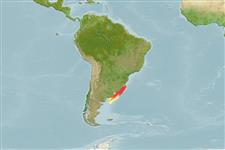
seewasser; brackwasser demersal; ozeanodrom (Ref. 51243); tiefenbereich ? - 200 m (Ref. 47377), usually 10 - 100 m (Ref. 27363). Subtropical; 31°S - 42°S, 62°W - 49°W (Ref. 54933)
Southwest Atlantic: Cabo de São Tomé, Rio de Janeiro, Brazil to Bonaerensis, Argentina.
Länge bei der ersten Reifung / Größe / Gewicht / Alter
Geschlechtsreife: Lm 15.9, range 17 - ? cm
Max length : 53.3 cm TL Männchen/unbestimmt; (Ref. 39376); common length : 37.0 cm TL Männchen/unbestimmt; (Ref. 7025); max. veröff. Alter: 26 Jahre (Ref. 7025)
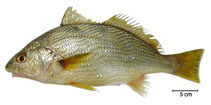
Rückenflossenstacheln (insgesamt) : 11; Rückenflossenweichstrahlen (insgesamt) : 21 - 25; Afterflossenstacheln: 2; Afterflossenweichstrahlen: 7 - 8. Upper part of body with many dark longitudinal stripes; no well defined dark spots at bases of pectoral fins (Ref. 27363).
Body shape (shape guide): fusiform / normal.
Especially abundant at about 100 m depth (Ref. 27363). Found over sand and mud bottoms (Ref. 47377).
Haimovici, M., 1988. Cohort analysis on the Argentine croaker (Umbrina canosai) exploited in South Brazil, Uruguay and Argentina. Publ. Com. Tec. Mixta Frente Marit. Argent. Urug. 4:33-40. (Ref. 7415)
IUCN Rote Liste Status (Ref. 130435: Version 2025-2 (Global))
Bedrohung für Menschen
Harmless
Nutzung durch Menschen
Fischereien: hoch kommerziell
Tools
Zusatzinformationen
Download XML
Internet Quellen
Schätzungen auf der Grundlage von Modellen
Bevorzugte Temperatur (Ref.
123201): 8 - 19.8, mean 14.8 °C (based on 242 cells).
Phylogenetischer Diversitätsindex (Ref.
82804): PD
50 = 0.5000 [Uniqueness, from 0.5 = low to 2.0 = high].
Bayesian length-weight: a=0.01023 (0.00811 - 0.01291), b=3.07 (3.05 - 3.09), in cm total length, based on LWR estimates for this species (Ref.
93245).
Trophische Ebene (Ref.
69278): 3.9 ±0.57 se; based on food items.
Widerstandsfähigkeit (Ref.
120179): mittel, Verdopplung der Population dauert 1,4 - 4,4 Jahre. (K=0.26-0.27).
Anfälligkeit der Fischerei (Ref.
59153): Low to moderate vulnerability (32 of 100).
🛈
Klimaanfälligkeit (Ref.
125649): Moderate to high vulnerability (49 of 100).
🛈
Nährstoffe (Ref.
124155): Calcium = 87.1 [46.8, 175.5] mg/100g; Iron = 1.14 [0.60, 2.03] mg/100g; Protein = 19.7 [18.6, 20.8] %; Omega3 = 0.415 [0.243, 0.670] g/100g; Selenium = 28.3 [14.6, 54.5] μg/100g; VitaminA = 18.5 [6.5, 62.6] μg/100g; Zinc = 0.746 [0.523, 1.092] mg/100g (wet weight);