Taxonomic Remarks
Some authors use the genus Triglopsis for this species. See the list of references in Eschmeyer (CofF ver. Sep. 2011: Ref. 88002). More studies are needed.
محیط زیست: محیط زیست / منطقه آب و هوایی / تغييرات عمق / محدوده توزیع
بوم شناسي
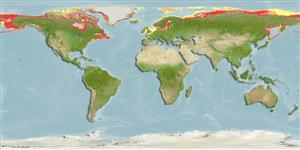
دريايي; آب شيرين; لب شور نزديك كف زي; تغييرات عمق 0 - 100 m (Ref. 58496). Polar; 83°N - 41°N, 180°W - 180°E
Atlantic and Arctic: Baltic coast of Sweden, Finland, Russia and southwestern to eastern Poland; western coast of Sweden to northern coast of Norway, eastward to White and Barents Sea basins. In Siberia eastward to about Anadyr estuary. Landlocked populations in Sweden, central Finland and Karelia (Ref. 59043). Arctic drainages of North America (Ref. 5723).
طول در اولین بلوغ / اندازه / وزن / سن
بلوغ: Lm ? range ? - ? cm
Max length : 60.0 cm TL جنس نر / بدون خواص جنسي; (Ref. 2058); common length : 30.0 cm TL جنس نر / بدون خواص جنسي; (Ref. 2058); بيشينه وزن گزارش شده: 260.00 g (Ref. 27547); بيشينه سن گزارش شده: 14 سال ها (Ref. 12193)
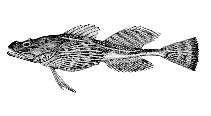
خارهاي باله پشتي (کل) : 7 - 9; شعاع نرم باله پشتي (کل) : 13 - 16; خارهاي باله مخرجي: 0; شعاع نرم باله مخرجي: 13 - 17; مهره ها: 37 - 42. Identified by the four bony protuberances on the top of the head (the protuberances are smaller in females and young and absent in the freshwater form), the chainlike lateral line, the sharp spines on the preoperculum, and the absence of palatine teeth (Ref. 27547). Gill rakers reduced to rounded, spiny protuberances (Ref. 27547). Soft dorsal often much enlarged in adult males; caudal truncate to slightly rounded (Ref. 27547). Young gray above, with three or four dark saddles below dorsal fins and a dark spot on dorsal side of caudal peduncle; adults are darker; spiny dorsal fin dusted with black; soft dorsal, anal, pectoral and caudal fins have dark bars; pelvic fins pale (Ref. 27547).
Body shape (shape guide): fusiform / normal.
Occurs in cold brackish and moderately saline water near the coast (Ref. 27547). Enters coastal rivers and may occur as far as 120 miles inland (Ref. 5723). Landlocked in lakes (Ref. 59043). Maximum depth reported at 100m (Ref. 35388). Benthic (Ref. 58426). Movements are limited to short onshore-offshore seasonal movements and mass movements of fry into shallow water in autumn (Ref. 28908, 28910). Moreover, there are no migrations of large numbers; movement into freshwater and long distances up rivers are apparently undertaken by relatively few individuals at a time (Ref. 27547). Diurnal from November to April but is largely nocturnal the rest of the year (Ref. 28905). Feeds on small crustaceans, fishes (Ref. 4968) and molluscs (Ref. 58426). Spawning takes place in shallow waters, male digs a groove in the gravel where pairing and egg laying occur. Move to deeper water in the spring, where they stay in summer (Ref. 35388). Landlocked populations are locally threatened (Ref. 59043).
Males become territorial and aggressive toward other males with the approach of the spawning season. Two or three days prior to spawning, the females become restless and swim about between short periods of rest. When a female swims over a male, he undulates his body from side to side and raises his spiny dorsal fin, If the female comes to rest near the male, he moves close to her in a series of short darts. Both then fan rhythymically with their pectoral fins, making a hole. The pair lie side by side, with the male's caudal fin twisted under that of the female. The male make rhythmic motions toward the female with his tail, and the motions apparently stimulate her to release her eggs (Ref. 28900, 28901). After spawning the female leaves the nest; the eggs are fanned and guarded by the male until hatching which occurs in the spring (Ref. 27547).
Robins, C.R., R.M. Bailey, C.E. Bond, J.R. Brooker, E.A. Lachner, R.N. Lea and W.B. Scott, 1991. Common and scientific names of fishes from the United States and Canada. Am. Fish. Soc. Spec. Publ. (20):183 p. (Ref. 3814)
وضعيت در فهرست قرمز IUCN (Ref. 130435: Version 2025-2 (Global))
خطر برای انسان ها
Harmless
استفاده انسانی
ماهي گيري – شيلات: معاش ماهیگیری
ابزارها
گزارش های ويژه
بارگيری XML
منابع اينترنتي
تخمینها بر اساس مدلها
دمای ترجیحی (مرجع
123201): -1.8 - 4.3, mean -1 °C (based on 6042 cells).
شاخص تنوع فیلوژنتیکی (مرجع
82804): PD
50 = 0.5000 [Uniqueness, from 0.5 = low to 2.0 = high].
Bayesian length-weight: a=0.00724 (0.00583 - 0.00901), b=3.13 (3.07 - 3.19), in cm total length, based on LWR estimates for this species (Ref.
93245).
سطح تروفیک (مرجع
69278): 3.9 ±0.62 se; based on food items.
جهندگی (مرجع
120179): پايين ، كم, كمينه زمان لازم براي دو برابر شدن جمعيت 5/4 – 14 سال (tm=3-5; tmax=14; Fec=792).
آسیبپذیری ماهیگیری (Ref.
59153): Moderate vulnerability (44 of 100).
🛈
مواد مغذی (Ref.
124155): Calcium = 73.6 [14.2, 243.1] mg/100g; Iron = 0.358 [0.135, 1.153] mg/100g; Protein = 18.6 [15.8, 20.9] %; Omega3 = 0.493 [0.205, 1.367] g/100g; Selenium = 13.3 [5.5, 31.9] μg/100g; VitaminA = 9.77 [2.06, 48.14] μg/100g; Zinc = 0.784 [0.313, 1.423] mg/100g (wet weight);