>
Eupercaria/misc (Various families in series Eupercaria) >
Sciaenidae (Drums or croakers)
Etymology: Cynoscion: Greek, kyon = dog + Greek, odous = teeth + Greek, skion, skiaina = barbel, red mullet (Ref. 45335).
More on authors: Bloch & Schneider.
Miljö: miljö / Klimatzon / djupintervall / distributionsområde
Ekologi
marina; brackvatten bottenlevande; havsvandrande (Ref. 51243); djupintervall 10 - 26 m (Ref. 54407). Subtropical; 17°C - 27°C (Ref. 54461); 47°N - 27°N, 82°W - 59°W
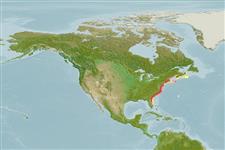
Western Atlantic: Nova Scotia, Canada to northern Florida, USA. Introduced in Europe (Ref. 122657).
Längd vid första mognad / Storlek / Vikt / Ålder
Könsmognad: Lm 17.9, range 14 - 22.5 cm
Max length : 98.0 cm TL hane/ej könsbestämd; (Ref. 40637); common length : 50.0 cm TL hane/ej könsbestämd; (Ref. 3702); publicerad maxvikt: 8.9 kg (Ref. 40637)
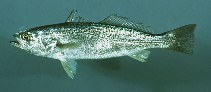
Taggstrålar i ryggfenan (totalt) : 11; Mjukstrålar i ryggfenan (totalt) : 25 - 29; Taggstrålar i analfenan: 2; Mjukstrålar i analfenan: 11 - 13. Body greenish grey above and silvery below, back with small spots forming undulating dotted lines. Pelvic fins and anal fin yellowish other fins pale, sometimes with a yellowish tinge. Inside of opercle dark, visible externally. Mouth large, oblique, lower jaw projecting. Upper jaw with a pair of large canine-like teeth at tip. Chin without barbels or pores. Snout with only 1 marginal pore. Gas bladder with a pair of nearly straight, horn-like appendages. Soft portion of dorsal fin covered with small scales up to 1/2 of fin height (Ref 51721).
Body shape (shape guide): fusiform / normal.
Occurs usually in shallow coastal waters over sand and sandy mud bottoms. Juveniles are euryhaline. During summer the fish move to their nursery and feeding grounds in river estuaries. Feeds mainly on crustaceans and fishes. Oviparous, with high fecundity (Ref. 54406). The species leave estuaries during the fall when water temperatures decrease, but are also known to overwinter in these areas. It has been reported that the fish cease feeding and die when the water temperature reaches 7.9 deg C and 3.3 deg. C, respectively (Ref. 122657). Utilized fresh and frozen; eaten steamed, pan-fried, broiled, microwaved and baked (Ref. 9988).
Robins, C.R. and G.C. Ray, 1986. A field guide to Atlantic coast fishes of North America. Houghton Mifflin Company, Boston, U.S.A. 354 p. (Ref. 7251)
Status på IUCN:s rödlista (Ref. 130435: Version 2025-2 (Global))
Hot mot människor
Harmless
Mänskliga användningsområden
Fiskeri: kommersiell; sportfisk: ja; Akvarium: Offentliga akvarier
Verktyg
Särskilda rapporter
Ladda ner XML
Internet-källor
Uppskattningar baserade på modeller
Önskad temperatur (Ref.
123201): 7.2 - 24.9, mean 12.7 °C (based on 172 cells).
Index för fylogenetisk mångfald (Ref.
82804): PD
50 = 0.5000 [Uniqueness, from 0.5 = low to 2.0 = high].
Bayesian length-weight: a=0.00776 (0.00678 - 0.00889), b=3.06 (3.04 - 3.08), in cm total length, based on LWR estimates for this species (Ref.
93245).
Trofisk nivå (Ref.
69278): 3.8 ±0.2 se; based on diet studies.
Resiliens (Ref.
120179): Mellan, lägsta populationsfördubblingstid 1,4-4,4 år (K=0.26-0.3; Fec = 45,000).
Prior r = 0.30, 95% CL = 0.20 - 0.46, Based on 1 full stock assessment.
Sårbarhet i fisket (Ref.
59153): Moderate to high vulnerability (45 of 100).
🛈
Sårbarhet för klimatet (Ref.
125649): High vulnerability (58 of 100).
🛈
Näringsämnen (Ref.
124155): Calcium = 57.1 [32.9, 114.6] mg/100g; Iron = 0.985 [0.510, 1.744] mg/100g; Protein = 19.1 [17.6, 20.8] %; Omega3 = 0.286 [0.169, 0.468] g/100g; Selenium = 23 [12, 48] μg/100g; VitaminA = 11.8 [3.9, 41.6] μg/100g; Zinc = 0.635 [0.458, 0.956] mg/100g (wet weight); based on
nutrient studies.