>
Perciformes/Cottoidei (Sculpins) >
Cottidae (Sculpins)
Etymology: Artediellus: Petrus (Peter) Artedi, (10 Mar.) 1705-35 (28 Sep.), a son of a clergyman from Anundsjö named Olaus Arctaedius, in the northern part of Sweden.In 1729 he changed his name from Arctaedius to Arctædi, a name still later simplified to Artedi (Ref. 45335).
Eponymy: Peter Artedi (1705–1735) was a Swedish ichthyologist, sometimes regarded as ‘the father of ichthyology”. [...] (Ref. 128868), visit book page.
More on authors: Jordan & Evermann.
Umwelt: Milieu / Klimazone / Tiefenbereich / Verbreitungsgebiet
Ökologie
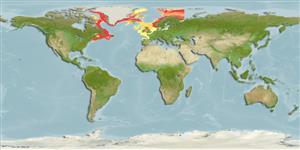
seewasser demersal; tiefenbereich 35 - 900 m (Ref. 35388). Temperate; -2°C - 4°C (Ref. 35388); 80°N - 41°N, 71°W - 41°E
Northwest Atlantic: Greenland and Canada to Cape Cod in Massachusetts, USA. Northeast Atlantic: Greenland, Iceland, the Faroes, Novaya Zemlya (but not White Sea) in Russia, southern part of Barents Sea, Scandinavian coast to Skagerrak, the Orkneys in Scotland, and Ireland.
Größe / Gewicht / Alter
Geschlechtsreife: Lm ? range ? - ? cm
Max length : 15.0 cm SL Männchen/unbestimmt; (Ref. 35388); 10.6 cm SL (female); common length : 10.5 cm TL Männchen/unbestimmt; (Ref. 4698)
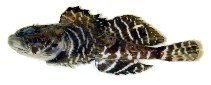
Gill membranes joined to each other under the throat, lateral line scales without bony knobs. Upper spine of the front gill cover curved upwards (Ref. 35388).
Body shape (shape guide): elongated.
Occur on sandy or muddy bottoms (Ref. 4698). Benthic (Ref. 58426). Feed on polychaetes, small mollusks and very rarely small crustaceans (Ref. 4698). Lives at temperatures of -1.7-4°C. Females lay 50-350 eggs with a diameter of 4mm in late summer (Ref. 35388).
Fedorov, V.V., 1986. Cottidae. p. 1243-1260. In P.J.P. Whitehead, M.-L. Bauchot, J.-C. Hureau, J. Nielsen and E. Tortonese (eds.) Fishes of the North-eastern Atlantic and the Mediterranean. UNESCO, Paris. Vol. 3. (Ref. 4698)
IUCN Rote Liste Status (Ref. 130435: Version 2025-2 (Global))
Bedrohung für Menschen
Harmless
Nutzung durch Menschen
Tools
Zusatzinformationen
Download XML
Internet Quellen
Schätzungen auf der Grundlage von Modellen
Bevorzugte Temperatur (Ref.
123201): 0.4 - 7.4, mean 3 °C (based on 1117 cells).
Phylogenetischer Diversitätsindex (Ref.
82804): PD
50 = 0.5000 [Uniqueness, from 0.5 = low to 2.0 = high].
Bayesian length-weight: a=0.00603 (0.00290 - 0.01252), b=3.14 (2.96 - 3.32), in cm total length, based on LWR estimates for this (Sub)family-body shape (Ref.
93245).
Trophische Ebene (Ref.
69278): 3.6 ±0.38 se; based on food items.
Widerstandsfähigkeit (Ref.
120179): niedrig, Verdopplung der Population dauert 4,5 - 14 Jahre. (Fec=50).
Anfälligkeit der Fischerei (Ref.
59153): Low vulnerability (10 of 100).
🛈
Nährstoffe (Ref.
124155): Calcium = 82.3 [31.6, 185.9] mg/100g; Iron = 0.378 [0.173, 0.871] mg/100g; Protein = 17.1 [14.9, 19.3] %; Omega3 = 0.65 [0.28, 1.57] g/100g; Selenium = 11 [3, 36] μg/100g; VitaminA = 31.4 [8.1, 110.6] μg/100g; Zinc = 0.765 [0.486, 1.338] mg/100g (wet weight);