>
Perciformes/Scorpaenoidei (Scorpionfishes) >
Sebastidae (Rockfishes, rockcods and thornyheads) > Sebastinae
Etymology: Sebastes: Greek, sebastes = august, venerable (Ref. 45335); mystinus: Name from the Latinized form of the Greek word μυ;stησ, mwhich means initiated one or mystic, c, interpreted by some as 'priest'; 19th century fishermen of Monterey, CA called the fish 'pêche prêtre' because of its dark coloration and its light band between the head bars that resembles a clerical collar (Ref. 103574).
More on authors: Jordan & Gilbert.
Ambiente: milieu / zona climatica / distribuzione batimetrica / gamma di distribuzione
Ecologia
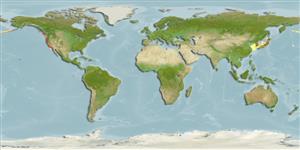
marino associati a barriera corallina; distribuzione batimetrica 0 - 550 m (Ref. 6885), usually 183 - 550 m (Ref. 6885). Subtropical; 1°C - 8°C (Ref. 131067); 45°N - 30°N, 125°W - 115°W
Eastern Pacific: northern limit is uncertain, at least from Vancouver Island in British Columbia, Canada (possibly Aleutian Islands, Alaska) to northern Baja California, Mexico.
Dimensione / Peso / Età
Maturità: Lm ? range ? - ? cm
Max length : 61.0 cm TL maschio/sesso non determinato; (Ref. 40637); peso massimo pubblicato: 3.8 kg (Ref. 40637); Età massima riportata: 44 anni (Ref. 39247)
Breve descrizione
Chiavi di identificazione | Morfologia | Morfometria
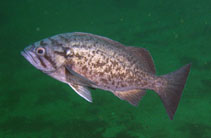
Spine dorsali (totale) : 13; Raggi dorsali molli (totale) : 15 - 17; Spine anali: 3; Raggi anali molli: 8 - 10; Vertebre: 26 - 27. Head spines weak to very weak - nasals present, preoculars usually present, supraocular, postocular and tympanic spines usually absent, coronal, parietal and nuchal spines absent (Ref. 27437). Eye diameter and mouth small (Ref. 27437). Deep bodied with large pectoral fins (Ref. 27437). Anal fin profile vertical or slanted posteriorly (Ref. 27437). Caudal fin indented (Ref. 6885). Blue or black in color with vague striping on forehead; lighter ventrally (Ref. 27437).
Branchiostegal rays: 7 (Ref. 36715).
Body shape (shape guide): fusiform / normal.
May be found near the surface or off the bottom, generally over shallow reefs, but also around kelp and over deep reefs (Ref. 2850). Juveniles are pelagic (Ref. 36715). Form schools, sometimes with other rockfishes (Ref. 2850). Feed mainly on krill (Ref. 2850), but also on tunicates, jellyfishes and fishes (Ref. 6885). Viviparous, with planktonic larvae (Ref. 36715). Young are important prey for fishes and other marine vertebrates (Ref. 2850).
Eschmeyer, W.N., E.S. Herald and H. Hammann, 1983. A field guide to Pacific coast fishes of North America. Boston (MA, USA): Houghton Mifflin Company. xii+336 p. (Ref. 2850)
Stato della Lista Rossa IUCN (Ref. 130435: Version 2025-2 (Global))
Minaccia per l'uomo
Harmless
Usi umani
Pesca: commerciale; Pesce da pesca sportiva: si; Acquario: Acquari pubblici
Strumenti
Rapporti speciali
Scarica XML
Fonti Internet
Stime basate su modelli
Temperatura preferita (Fonte Biblio.
123201): 0.8 - 7.9, mean 4.2 °C (based on 65 cells).
Indice di diversità filogenetica (Fonte Biblio.
82804): PD
50 = 0.5000 [Uniqueness, from 0.5 = low to 2.0 = high].
Bayesian length-weight: a=0.01000 (0.00490 - 0.02040), b=3.09 (2.92 - 3.26), in cm total length, based on LWR estimates for this Genus-body shape (Ref.
93245).
Livello trofico (Fonte Biblio.
69278): 2.7 ±0.1 se; based on diet studies.
Resilienza (Fonte Biblio.
120179): Basso, tempo minimo di raddoppiamento della popolazione 4.5 - 14 anni (K=0.17 (?); tm=3-5; tmax=44).
Vulnerabilità della pesca (Ref.
59153): Moderate to high vulnerability (48 of 100).
🛈
Nutrienti (Ref.
124155): Calcium = 13.9 [5.0, 45.6] mg/100g; Iron = 0.34 [0.13, 0.81] mg/100g; Protein = 19 [18, 20] %; Omega3 = 0.408 [0.161, 1.050] g/100g; Selenium = 66.4 [22.2, 217.5] μg/100g; VitaminA = 36.5 [11.8, 115.4] μg/100g; Zinc = 0.618 [0.306, 1.205] mg/100g (wet weight);