>
Perciformes/Scorpaenoidei (Scorpionfishes) >
Sebastidae (Rockfishes, rockcods and thornyheads) > Sebastinae
Etymology: Sebastes: Greek, sebastes = august, venerable (Ref. 45335); ciliatus: Name from Latin 'ciliatus' meaning 'eyelash' (Ref. 27436) or 'eyelid', referring to the numerous accessory scales (similar to fringing eyelashes) on the psoterior field of the larger scales in most species of Sebastes (Ref. 53613).
Ambiente: milieu / zona climatica / distribuzione batimetrica / gamma di distribuzione
Ecologia
marino demersale; distribuzione batimetrica 5 - 160 m (Ref. 53613). Temperate; 58°N - 50°N
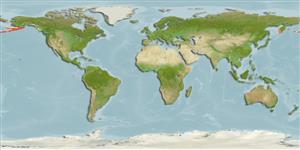
North Pacific: western Aleutian Islands and eastern Bering Sea, through the Gulf of Alaska, to southeast Alaska; including south to Johnstone Strait, British Columbia.
Lunghezza alla prima maturità / Dimensione / Peso / Età
Maturità: Lm 29.0 range ? - ? cm
Max length : 53.0 cm TL maschio/sesso non determinato; (Ref. 27437); peso massimo pubblicato: 1.8 kg (Ref. 40637); Età massima riportata: 67 anni (Ref. 39247)
Breve descrizione
Chiavi di identificazione | Morfologia | Morfometria
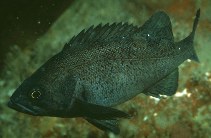
Spine dorsali (totale) : 13; Raggi dorsali molli (totale) : 15; Spine anali: 3; Raggi anali molli: 8. Head spines weak to very weak - nasals usually present, parietals usually absent, preocular, supraocular, postocular, tympanic, coronal and nuchal spines absent (Ref. 27437). Two distinct types, (1) dark dusky - uniformly dark or dusky in color, symphyseal knob absent and, (2) light dusky - a larger, greenish brown fish, lighter ventrally, fins tinged with pink or orange, symphyseal knob present (Ref. 27437). Caudal fin slightly indented (Ref. 6885).
Body shape (shape guide): fusiform / normal.
Found hovering in loose organized groups just above rocky reefs and along shorelines, or may rest singly upon rocky substrate (Ref. 27436). Feed by picking and seizing food items that are either drifting or suspended in the water column (Ref. 27302). Viviparous (Ref. 34817). Sold as fresh or frozen fillets; eaten as fish cakes (Ref. 27436). Captured by the nearshore jig fishery and has been reported to comprise up to 25% of the catch in the 'black rockfish' jig fishery of the northern Gulf of Alaska (citation in Ref. 53613).
Ciclo vitale e comportamento di accoppiamento
Maturità | Riproduzione | Deposizione | Uova | Fecondità | Larve
Eschmeyer, W.N., E.S. Herald and H. Hammann, 1983. A field guide to Pacific coast fishes of North America. Boston (MA, USA): Houghton Mifflin Company. xii+336 p. (Ref. 2850)
Stato della Lista Rossa IUCN (Ref. 130435: Version 2025-2 (Global))
Minaccia per l'uomo
Harmless
Usi umani
Pesca: scarso interesse commerciale; Pesce da pesca sportiva: si
Strumenti
Rapporti speciali
Scarica XML
Fonti Internet
Stime basate su modelli
Temperatura preferita (Fonte Biblio.
123201): 1.2 - 5.8, mean 4.1 °C (based on 65 cells).
Indice di diversità filogenetica (Fonte Biblio.
82804): PD
50 = 0.5000 [Uniqueness, from 0.5 = low to 2.0 = high].
Bayesian length-weight: a=0.01000 (0.00490 - 0.02040), b=3.09 (2.92 - 3.26), in cm total length, based on LWR estimates for this Genus-body shape (Ref.
93245).
Livello trofico (Fonte Biblio.
69278): 3.4 ±0.43 se; based on food items.
Resilienza (Fonte Biblio.
120179): Molto basso, tempo minimo di raddoppiamento della popolazione più di 14 anni (tmax=67).
Prior r = 0.24, 95% CL = 0.16 - 0.35, Based on 1 full stock assessment.
Vulnerabilità della pesca (Ref.
59153): Moderate vulnerability (41 of 100).
🛈