>
Eupercaria/misc (Various families in series Eupercaria) >
Moronidae (Temperate basses)
Etymology: Dicentrarchus: Greek, di = two + Greek, kentron = sting + Greek, archos = anus (Ref. 45335).
More on author: Bloch.
Milieu: milieu / Klimaatzone / Diepte / verspreidingsgebied
Ecologie
marien; brak water pelagic-neritic; diepte 30 - ? m (Ref. 5990). Subtropical; 51°N - 10°N
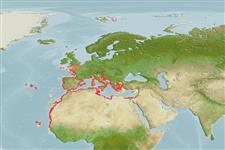
Eastern Atlantic: English Channel (occasional) southward along the coasts of Europe and Morocco to Senegal and the Canary Islands; also southern Mediterranean and the Gulf of Suez.
Lengte bij maturiteit / Grootte / Gewicht / Leeftijd
Maturiteit: Lm 21.6 range ? - ? cm
Max length : 70.0 cm TL mannelijk / geslacht onbekend; (Ref. 57391); common length : 30.0 cm TL mannelijk / geslacht onbekend; (Ref. 3397)
Dorsale stekels (totaal) : 9 - 10; Dorsale zachte stralen (totaal) : 12 - 14; Anale stekels: 3; Anale zachte stralen: 10 - 12. Diagnosis: elongate fish with 2 separate dorsal fins and a rather deep caudal peduncle; vomerine teeth patch anchor-shaped, with the posterior teeth extending to the midline of palate; scales on interorbital space ctenoid; opercle with 2 flat spines; lower preopercular margin with large, forward-pointing spines; caudal fin moderately forked; scales small (Ref. 57391).
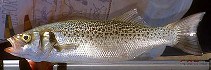
Coloration: silvery grey, back bluish in life; juveniles and adults with small dark markings scattered over back and sides; a very distinct black spot on opercle (Ref. 57391).
Body shape (shape guide): fusiform / normal.
Coastal species (Ref. 4197), found in coastal marine and brackish waters (Ref. 57391). Occurs on various kinds of bottoms, including sand, muddy sand and rocks; occasionally occurring in rivers (Ref. 6916, 57391). Also capable of living in hypersaline habitats (Sine Saloum in Senegal)(Ref. 57391). Feeds mainly on shrimps and mollusks, also fishes (Ref. 5990).
Smith, C.L., 1990. Moronidae. p. 692-694. In J.C. Quero, J.C. Hureau, C. Karrer, A. Post and L. Saldanha (eds.) Check-list of the fishes of the eastern tropical Atlantic (CLOFETA). JNICT, Lisbon; SEI, Paris; and UNESCO, Paris. Vol. 2. (Ref. 6916)
Status op de Rode Lijst van het IUCN (Ref. 130435: Version 2025-2 (Global))
Gevaar voor de mens
Harmless
Gebruik door de mens
Visserij: van minder commercieel belang; sportvis: ja
Tools
Speciale rapporten
Download XML
Internetbronnen
Schattingen op basis van modellen
Gewenste temperatuur (Ref.
123201): 13.3 - 20.7, mean 17.3 °C (based on 39 cells).
Fylogenetische diversiteitsindex (Ref.
82804): PD
50 = 0.7656 [Uniqueness, from 0.5 = low to 2.0 = high].
Bayesian length-weight: a=0.00813 (0.00634 - 0.01043), b=3.03 (2.96 - 3.10), in cm total length, based on LWR estimates for this species (Ref.
93245).
Trofisch niveau (Ref.
69278): 3.9 ±0.65 se; based on food items.
Weerstandsvermogen (Ref.
120179): Gemiddeld, minimale populatieverdubbelingstijd 1,4-4,4 jaar (K=0.07-0.16).
Prior r = 0.25, 95% CL = 0.16 - 0.37, Based on 1 full stock assessment.
Kwetsbaarheid van de visserij (Ref.
59153): Moderate vulnerability (36 of 100).
🛈
Kwetsbaarheid voor het klimaat (Ref.
125649): High to very high vulnerability (74 of 100).
🛈
Voedingsstoffen (Ref.
124155): Calcium = 35.4 [3.9, 188.9] mg/100g; Iron = 0.815 [0.282, 2.003] mg/100g; Protein = 20.5 [19.2, 21.9] %; Omega3 = 0.345 [0.187, 0.624] g/100g; Selenium = 10.5 [3.3, 29.4] μg/100g; VitaminA = 9.83 [2.35, 42.99] μg/100g; Zinc = 0.716 [0.328, 1.624] mg/100g (wet weight); based on
nutrient studies.