>
Gobiiformes (Gobies) >
Microdesmidae (Wormfishes) > Microdesminae
Etymology: Microdesmus: Greek, mikros = small + Greek, desmos = link (Ref. 45335).
Milieu: milieu / Klimaatzone / Diepte / verspreidingsgebied
Ecologie
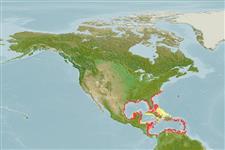
marien demersaal; diepte 5 - 10 m (Ref. 10815). Subtropical; 37°N - 8°N, 98°W - 60°W
Western Atlantic: Bermuda, North Carolina (USA), and northern Gulf of Mexico to the Cayman Islands. Eastern Atlantic: only known from two specimens (one extant) from Joal, Senegal (Ref. 10815, 81289). This species’ appearance in brackish waters of West Africa is likely to be very rare, but cannot be discounted (Ref. 81289).
Grootte / Gewicht / Leeftijd
Maturiteit: Lm ? range ? - ? cm
Max length : 27.0 cm TL mannelijk / geslacht onbekend; (Ref. 7251)
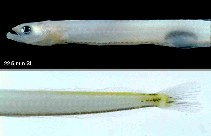
Dorsale stekels (totaal) : 19 - 23. Diagnosis: 62-80 (usually 66-75) total dorsal fin rays, including 19-23 spines; 36-52 (usually 40-47) total anal fin rays; anal fin usually originating between verticals from dorsal fin elements 25-31; caudal fin rounded (Ref. 81289).
Coloration: (based on description of juvenile pigmentation, by Smith&Thacker 2000): body tan, with melanophores scattered over flanks and dorsum, forming a stripe on dorsum and a thinner stripe on flanks; mottled pigmentation on head (Ref. 81289).
Body shape (shape guide): eel-like.
Known from muddy littoral and estuarine habitats (Ref. 81289). Burrows in shallow muddy and sandy bottoms (Ref. 7251). Postlarvae and early juveniles (to ca 2-2.5 cm SL) may occur in surface plankton to distances of 15 km or more offshore; subadults and adults occasionally found swimming near the surface at night (Ref. 10815).
Levenscyclus en paargedrag
Maturiteit | Voortplanting | Paaien | Eieren | Fecunditeit | Larven
Robins, C.R. and G.C. Ray, 1986. A field guide to Atlantic coast fishes of North America. Houghton Mifflin Company, Boston, U.S.A. 354 p. (Ref. 7251)
Status op de Rode Lijst van het IUCN (Ref. 130435: Version 2025-2 (Global))
Gevaar voor de mens
Harmless
Gebruik door de mens
Tools
Speciale rapporten
Download XML
Internetbronnen
Schattingen op basis van modellen
Gewenste temperatuur (Ref.
123201): 23.3 - 28.3, mean 27.2 °C (based on 426 cells).
Fylogenetische diversiteitsindex (Ref.
82804): PD
50 = 0.5000 [Uniqueness, from 0.5 = low to 2.0 = high].
Bayesian length-weight: a=0.00102 (0.00046 - 0.00225), b=3.06 (2.88 - 3.24), in cm total length, based on all LWR estimates for this body shape (Ref.
93245).
Trofisch niveau (Ref.
69278): 3.9 ±0.5 se; based on size and trophs of closest relatives
Kwetsbaarheid van de visserij (Ref.
59153): Low vulnerability (17 of 100).
🛈