>
Carangiformes (Jacks) >
Carangidae (Jacks and pompanos) > Caranginae
Etymology: Chloroscombrus: Greek, chloros = green + Greek, skombros = the name of several fishes, a mackerel (Ref. 45335).
More on author: Linnaeus.
Umwelt: Milieu / Klimazone / Tiefenbereich / Verbreitungsgebiet
Ökologie
seewasser; brackwasser pelagic-neritic; tiefenbereich 0 - 110 m (Ref. 114025). Subtropical; 42°N - 41°S, 98°W - 14°E
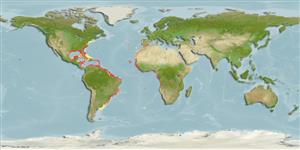
Western Atlantic: Massachusetts to Florida, USA and Bermuda to Uruguay; throughout Caribbean Sea and Gulf of Mexico (Ref. 9626); Bahamas, Antilles, along Central and South American coasts to Uruguay (Ref. 26938). Eastern Atlantic: Spain to Angola (Ref. 57392). First recorded from the Mediterranean Sea (Ref. 128468).
Replaced by Chloroscombrus orqueta in eastern Pacific. These two species have not been adequately studied and may prove to be conspecific.
Länge bei der ersten Reifung / Größe / Gewicht / Alter
Geschlechtsreife: Lm 12.4, range 10 - ? cm
Max length : 65.0 cm TL Männchen/unbestimmt; (Ref. 57392); common length : 25.0 cm TL Männchen/unbestimmt; (Ref. 5217); max. veröff. Gewicht: 121.00 g (Ref. 128468)
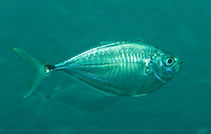
Rückenflossenstacheln (insgesamt) : 9; Rückenflossenweichstrahlen (insgesamt) : 25 - 28; Afterflossenstacheln: 3; Afterflossenweichstrahlen: 25 - 28. Diagnosis: body compressed and deep (depth comprised from 2.3 to 2.8 times in fork length) (Ref. 57392), its ventral profile distinctly more convex than the dorsal (Ref. 26938, 57392). Snout very short, its tip blunt, upper jaw extending almost to behind level of anterior eye margin; 2 dorsal fins, the first with 8 spines, the second with 1 spine and 25-28 soft rays; anal fin with 2 detached spines, followed by 1 spine and 25-28 soft rays; upper lobe of caudal fin longer than the lower; small, cycloid scales covering most of body, including chest; 5-15 weak scutes on posterior part of lateral line, at level of caudal peduncle, the latter without bilateral keels (Ref. 57392). Metallic blue above, silvery below; caudal peduncle with black saddle spot (Ref. 3197).
Coloration: back greenish or bluish, sides silvery-white; a dark, saddle-shaped blotch on caudal peduncle just before caudal fin, and another at upper angle of gill cover (Ref. 57392).
Body shape (shape guide): fusiform / normal.
Adults are found over soft bottoms of the continental shelf; sometimes forming schools near the surface (Ref. 5217). Marine pelagic species very common in coastal lagoons and estuaries (Ref. 57392). They feed on fish, cephalopods, zooplankton and detritus (Ref. 28587). Juveniles common in brackish estuaries and often associated with jellyfish (Ref. 5217). Marketed fresh and salted.
Smith-Vaniz, W.F., J.-C. Quéro and M. Desoutter, 1990. Carangidae. p. 729-755. In J.C. Quero, J.C. Hureau, C. Karrer, A. Post and L. Saldanha (eds.) Check-list of the fishes of the eastern tropical Atlantic (CLOFETA). JNICT, Lisbon; SEI, Paris; and UNESCO, Paris. Vol. 2. (Ref. 7097)
IUCN Rote Liste Status (Ref. 130435: Version 2025-2 (Global))
Bedrohung für Menschen
Harmless
Nutzung durch Menschen
Fischereien: kommerziell
Tools
Zusatzinformationen
Download XML
Internet Quellen
Schätzungen auf der Grundlage von Modellen
Bevorzugte Temperatur (Ref.
123201): 23.2 - 28, mean 26.2 °C (based on 552 cells).
Phylogenetischer Diversitätsindex (Ref.
82804): PD
50 = 0.7500 [Uniqueness, from 0.5 = low to 2.0 = high].
Bayesian length-weight: a=0.01202 (0.01068 - 0.01353), b=2.94 (2.91 - 2.97), in cm total length, based on LWR estimates for this species (Ref.
93245).
Trophische Ebene (Ref.
69278): 3.5 ±0.2 se; based on diet studies.
Generation time: 5.0 ( na - na) years. Estimated as median ln(3)/K based on 2
growth studies.
Widerstandsfähigkeit (Ref.
120179): mittel, Verdopplung der Population dauert 1,4 - 4,4 Jahre. (K=0.22-0.56; assumed tm=1-2).
Prior r = 0.57, 95% CL = 0.37 - 0.85, Based on 3 data-limited stock assessments.
Anfälligkeit der Fischerei (Ref.
59153): Low to moderate vulnerability (29 of 100).
🛈
Klimaanfälligkeit (Ref.
125649): High to very high vulnerability (75 of 100).
🛈
Nährstoffe (Ref.
124155): Calcium = 90.6 [51.1, 199.0] mg/100g; Iron = 1.79 [1.02, 3.33] mg/100g; Protein = 20.3 [19.1, 21.5] %; Omega3 = 0.442 [0.268, 0.757] g/100g; Selenium = 26.1 [13.5, 51.0] μg/100g; VitaminA = 6.02 [1.87, 18.28] μg/100g; Zinc = 0.834 [0.576, 1.190] mg/100g (wet weight);