>
Gobiiformes (Gobies) >
Gobiidae (Gobies) > Gobiinae
Etymology: Rhinogobiops: Greek, rhinos = nose + Latin, gobius = gudgeon Greek, ops = similar to; nicholsii: Named after Capt. H.E. Nichols, U.S.N, its discoverer (Ref. 6885).
Eponymy: Captain Henry Ezra Nichols (d: 1899) was a US Navy officer at the Department of Alaska. [...] (Ref. 128868), visit book page.
More on author: Bean.
Milieu: milieu / Klimaatzone / Diepte / verspreidingsgebied
Ecologie
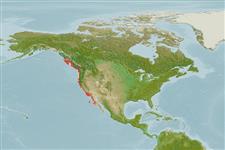
marien demersaal; diepte 0 - 106 m (Ref. 2850). Subtropical; 55°N - 27°N, 136°W - 114°W
Eastern Pacific: Wales Island, northern British Columbia, Canada to Punta Rompiente, central Baja California, Mexico.
Grootte / Gewicht / Leeftijd
Maturiteit: Lm ? range ? - ? cm
Max length : 15.0 cm TL mannelijk / geslacht onbekend; (Ref. 2850); max. gerapporteerde leeftijd: 5 Jaren (Ref. 56049)
Korte beschrijving
Determinatiesleutels | Morfologie | Morfometrie
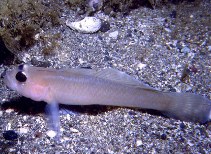
Dorsale stekels (totaal) : 5 - 7; Dorsale zachte stralen (totaal) : 12 - 14; Anale stekels: 0; Anale zachte stralen: 11 - 12. Caudal rounded.
Body shape (shape guide): fusiform / normal.
Found usually in sandy areas near rocks. Occurs from intertidal areas to 106 m depth. Retreats to rocks or holes when approached. Young are found usually offshore among plankton. Oviparous (Ref. 56079). A protogynous hermaphrodite (Ref. 34256). Forms permanent harem groups composed of a single male and several smaller females (Ref. 55367). Eggs are guarded by the male (Ref. 56079).
Nesting occurs from April-October. Male cleans spawning site under rock, then attracts female by rising from bottom to display his black pelvic disk. Male guards nest after female lays eggs. Protogynous (Ref. 13452, 35501). Sex reversal is completed in less than 5 months (Ref. 34185, 34256). A monandric species (Ref. 55367). Length at sex change = 6.9 cm TL (Ref. 55367). Also Ref. 103751.
Eschmeyer, W.N., E.S. Herald and H. Hammann, 1983. A field guide to Pacific coast fishes of North America. Boston (MA, USA): Houghton Mifflin Company. xii+336 p. (Ref. 2850)
Status op de Rode Lijst van het IUCN (Ref. 130435: Version 2025-2 (Global))
Gevaar voor de mens
Harmless
Gebruik door de mens
Visserij: commercieel; Aquarium: Publieke aquaria
Tools
Speciale rapporten
Download XML
Internetbronnen
Schattingen op basis van modellen
Gewenste temperatuur (Ref.
123201): 8.3 - 12.8, mean 9.8 °C (based on 66 cells).
Fylogenetische diversiteitsindex (Ref.
82804): PD
50 = 1.0000 [Uniqueness, from 0.5 = low to 2.0 = high].
Bayesian length-weight: a=0.01023 (0.00477 - 0.02194), b=3.01 (2.83 - 3.19), in cm total length, based on LWR estimates for this (Sub)family-body shape (Ref.
93245).
Trofisch niveau (Ref.
69278): 3.4 ±0.58 se; based on food items.
Weerstandsvermogen (Ref.
120179): Gemiddeld, minimale populatieverdubbelingstijd 1,4-4,4 jaar (tmax=5).
Kwetsbaarheid van de visserij (Ref.
59153): Low vulnerability (10 of 100).
🛈
Voedingsstoffen (Ref.
124155): Calcium = 162 [79, 343] mg/100g; Iron = 1.32 [0.70, 2.56] mg/100g; Protein = 18.5 [16.6, 20.1] %; Omega3 = 0.4 [0.2, 0.7] g/100g; Selenium = 21.9 [10.9, 43.4] μg/100g; VitaminA = 18.8 [5.8, 59.0] μg/100g; Zinc = 1.06 [0.73, 1.59] mg/100g (wet weight);