>
Perciformes/Zoarcoidei (Eelpouts and pricklebacks) >
Stichaeidae (Pricklebacks) > Xiphisterinae
Etymology: Anoplarchus: Greek, ana = up + Greek, oplon = shield + Greek, archos = anus (Ref. 45335).
More on author: Gill.
Entorno: milieu / zona climática / rango de profundidad / gama de distribución
Ecología
marino demersal; rango de profundidad 1 - 30 m (Ref. 2850). Temperate; 66°N - 32°N
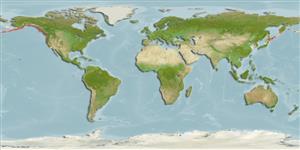
Eastern Pacific: Pribilof Islands, Alaska to Santa Rosa Island and Trinidad Bay, southern California, USA.
Tamaño / Peso / Edad
Madurez: Lm ? range ? - ? cm
Max length : 20.0 cm TL macho / no sexado; (Ref. 2850)
Descripción breve
Claves de identificación | Morfología | Morfometría
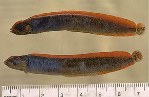
Espinas dorsales (total) : 55 - 58; Radios blandos dorsales (total) : 0; Espinas anales: 0; Radios blandos anales: 39 - 40; Vértebra: 58 - 61. Caudal with convex outer margin (Ref. 6885). Color very variable- may be light to dark gray with olivaceous overtones, brown to dark brown with or without reddish overtones, or purple to almost black. Females are less varied in color, but show more pattern, usually having green grayish backgrounds with brownish reticulations, or dark brownish backgrounds with subdued reticulation. Belly pale. In the males, the cockscomb and under surface of head are pale, rather yellowish, and without speckling. In the female, the head is more speckled and mottled. There is a gray bar across the base of the caudal peduncle. At breeding season, the male develops bright orange colors on its anal and pectoral fins, and reddish on the caudal and dorsal fins (Ref. 6885).
Facultative air-breathing (Ref. 126274); Usually found in intertidal areas under rocks (Ref. 2850). May remain out of water under rocks or seaweed (Ref. 31184). Green algae is an important food item but may also feed on polychaete worms, crustaceans and mollusks (Ref. 6885). Breathes air (Ref. 31184) and can remain out of water for 15-25 hours if kept moist (Ref. 51276).
Spawning individuals are territorial. The female guards the egg mass deposited between rocks and shells by bending her body over the eggs. She fans the eggs by moving the posterior part of her body (Ref. 6885). In the aquarium, males mate with several females (Ref. 39998).
Eschmeyer, W.N., E.S. Herald and H. Hammann, 1983. A field guide to Pacific coast fishes of North America. Boston (MA, USA): Houghton Mifflin Company. xii+336 p. (Ref. 2850)
Situación en la Lista Roja de la UICN (Ref. 130435: Version 2025-2 (Global))
Amenaza para el ser humano
Harmless
Usos humanos
Herramientas
Informes especiales
Descargar XML
Fuentes de Internet
Estimaciones basadas en modelos
Temperatura preferida (Referencia
123201): 5.9 - 13.4, mean 8.9 °C (based on 428 cells).
Índice de diversidad filogenética (Referencia
82804): PD
50 = 0.7500 [Uniqueness, from 0.5 = low to 2.0 = high].
Bayesian length-weight: a=0.00389 (0.00180 - 0.00842), b=3.12 (2.94 - 3.30), in cm total length, based on all LWR estimates for this body shape (Ref.
93245).
Nivel trófico (Referencia
69278): 2.9 ±0.1 se; based on diet studies.
Resiliencia (Referencia
120179): Medio, población duplicada en un tiempo mínimo de 1.4-4.4 años (tm=2-3; Fec=2,700).
Vulnerabilidad pesquera (Ref.
59153): Low vulnerability (10 of 100).
🛈