Environnement : milieu / zone climatique / profondeur / gamme de distribution
Écologie
marin récifal; profondeur 0 - 10 m (Ref. 9710). Tropical
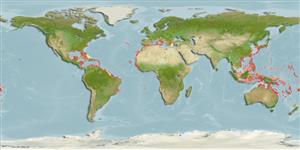
Western Atlantic: Bermuda, Florida (USA), and northern Gulf of Mexico to Brazil. Eastern Atlantic: Mauritania and the Canary Islands to about South Africa. Also known in the southern parts of Mediterranean, including the following most southern localities of the northern coast: Torremolinos and Taramay near Motril (Spain), Sicily, Kyra Island (Gulf of Aigina) and near Palaea Epidavros, Peloponnes (Greece) (Ref. 5298). Northwest Pacific: Japan (Ref. 559, 9137, 35771) and Taiwan.
Taille / Poids / Âge
Maturité: Lm ? range ? - ? cm
Max length : 12.0 cm TL mâle / non sexé; (Ref. 13628)
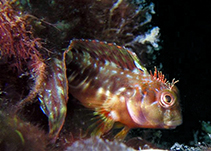
Épines dorsales (Total) : 12; Rayons mous dorsaux (Total) : 14 - 15; Épines anales: 2; Rayons mous anaux: 14 - 17. Resembles P. yatabei but easily distinguished by a median series of cirri on nape. A short supraorbital cirrus present (Ref. 559). Dull green or olive with dark bars on body which extend into lower part of dorsal fin (Ref. 13442).
Body shape (shape guide): fusiform / normal; Cross section: circular.
Adults inhabit shallow rocky areas and tide pools. They hide in empty Strombus gigas shells (Ref. 13628), holes or troughs of rocks, or between algae (Ref. 5981). Herbivorous (Ref. 13442). Feed on invertebrates as juveniles and shift to diet of algae as adults (Ref. 94105). Unusual erectile nuchal crest (Ref. 41019). Oviparous. Eggs are demersal and adhesive (Ref. 205), and are attached to the substrate via a filamentous, adhesive pad or pedestal (Ref. 94114). Larvae are planktonic, often found in shallow, coastal waters (Ref. 94114).
Cycle de vie et comportement reproducteur
Maturité | Reproduction | Frai | Œufs | Fécondité | Larves
Oviparous, distinct pairing (Ref. 205).
Robins, C.R. and G.C. Ray, 1986. A field guide to Atlantic coast fishes of North America. Houghton Mifflin Company, Boston, U.S.A. 354 p. (Ref. 7251)
Statut dans la liste rouge de l'IUCN (Ref. 130435: Version 2025-2 (Global))
Menace pour l'homme
Harmless
Utilisations par l'homme
Pêcheries: sans intérêt; Aquarium: Commercial
Outils
Articles particuliers
Télécharger en XML
Sources Internet
Estimations basées sur des modèles
Température préférée (Réf.
123201): 19.3 - 29.1, mean 27.4 °C (based on 3129 cells).
Indice de diversité phylogénétique (Réf.
82804): PD
50 = 0.5078 [Uniqueness, from 0.5 = low to 2.0 = high].
Bayesian length-weight: a=0.01047 (0.00598 - 0.01832), b=2.95 (2.80 - 3.10), in cm total length, based on LWR estimates for this species & (Sub)family-body (Ref.
93245).
Niveau trophique (Réf.
69278): 2.5 ±0.1 se; based on diet studies.
Résilience (Réf.
120179): Haut, temps minimum de doublement de population inférieur à 15 mois (Preliminary K or Fecundity.).
Vulnérabilité de la pêche (Ref.
59153): Low vulnerability (10 of 100).
🛈
Nutriments (Ref.
124155): Calcium = 121 [68, 196] mg/100g; Iron = 0.837 [0.517, 1.314] mg/100g; Protein = 18.6 [17.5, 19.6] %; Omega3 = 0.129 [0.081, 0.206] g/100g; Selenium = 19.4 [11.4, 35.1] μg/100g; VitaminA = 119 [39, 369] μg/100g; Zinc = 2.16 [1.51, 2.99] mg/100g (wet weight);