>
Blenniiformes (Blennies) >
Blenniidae (Combtooth blennies) > Salariinae
Etymology: Parablennius: Greek, para = the side of + Greek, blennios = mucus (Ref. 45335).
More on author: Poey.
Ambiente: milieu / zona climática / intervalo de profundidade / gama de distribuição
Ecologia
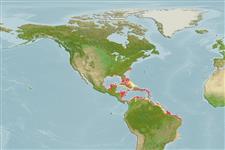
marinhas associadas(os) a recifes; intervalo de profundidade 0 - 10 m (Ref. 9710). Subtropical; 36°N - 27°S, 98°W - 34°W
Western Atlantic: New York (USA), Bermuda, the Bahamas, Gulf of Mexico to southern Brazil.
Tamanho / Peso / Idade
Maturidade: Lm ? range ? - ? cm
Max length : 8.5 cm TL macho/indeterminado; (Ref. 7251)
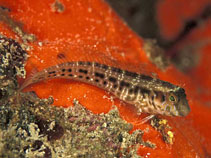
Espinhos dorsais (total) : 12; Raios dorsais moles (total) : 18; Espinhos anais: 2; Raios anais moles: 19 - 20. No median row of cirri; supraorbital cirri branched (Ref. 26938). With numerous small brown spots; small black spot at front of dorsal fin; edge of anal fin pale (Ref. 13442).
Body shape (shape guide): fusiform / normal.
Facultative air-breathing in the genus (Ref. 126274); Adults inhabit eroded basins and limestone boulders covered by an algal mat, sea fans, etc. (Ref. 5521). Sometimes around mangrove roots, young are sometimes found in floating Sargassum (Ref. 26938). Omnivorous, but feed mostly on algae (Ref. 13442). Oviparous. Eggs are demersal and adhesive (Ref. 205), and are attached to the substrate via a filamentous, adhesive pad or pedestal (Ref. 94114). Larvae are planktonic, often found in shallow, coastal waters (Ref. 94114).
Ciclo de vida e comportamento de acasalamento
Maturidade | Reprodução | Desova | Ovos | Fecundidade | Larvas
Oviparous, distinct pairing (Ref. 205).
Robins, C.R. and G.C. Ray, 1986. A field guide to Atlantic coast fishes of North America. Houghton Mifflin Company, Boston, U.S.A. 354 p. (Ref. 7251)
Categoria na Lista Vermelha da IUCN (Ref. 130435: Version 2025-2 (Global))
Ameaça para o homem
Harmless
Utilização humana
Pescarias: sem interesse; Aquário: Espécies comerciais
Ferramentas
Relatórios especiais
Descarregue XML
Fontes da internet
Estimativas baseadas em modelos
Temperatura preferida (Ref.
123201): 23.5 - 28.2, mean 27.2 °C (based on 572 cells).
Índice de diversidade filogenética (Ref.
82804): PD
50 = 0.5000 [Uniqueness, from 0.5 = low to 2.0 = high].
Bayesian length-weight: a=0.01096 (0.00467 - 0.02573), b=2.99 (2.81 - 3.17), in cm total length, based on LWR estimates for this Genus-body shape (Ref.
93245).
Nível Trófico (Ref.
69278): 2.5 ±0.23 se; based on food items.
Resiliência (Ref.
120179): Elevada, tempo mínimo de duplicação da população menor que 15 meses (Preliminary K or Fecundity.).
Vulnerabilidade da pesca (Ref.
59153): Low vulnerability (10 of 100).
🛈
Nutrientes (Ref.
124155): Calcium = 97.8 [37.6, 198.2] mg/100g; Iron = 0.951 [0.516, 1.730] mg/100g; Protein = 19.3 [18.1, 20.4] %; Omega3 = 0.208 [0.110, 0.386] g/100g; Selenium = 8.81 [4.00, 19.36] μg/100g; VitaminA = 78.6 [21.8, 279.3] μg/100g; Zinc = 1.65 [1.02, 2.60] mg/100g (wet weight);