>
Blenniiformes (Blennies) >
Blenniidae (Combtooth blennies) > Salariinae
Etymology: Hypsoblennius: Greek, hypsi = high + Greek, blennios = mucus (Ref. 45335).
Eponymy: Nicholas Marcellus Hentz (1797–1856) was a French-born American entomologist, arachnologist and teacher. [...] (Ref. 128868), visit book page.
More on author: Lesueur.
Umwelt: Milieu / Klimazone / Tiefenbereich / Verbreitungsgebiet
Ökologie
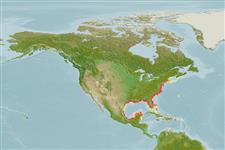
seewasser riff-verbunden. Temperate; 46°N - 18°N, 98°W - 62°W
Western Atlantic: New Jersey (occasionally Nova Scotia in Canada) to Texas, including southern Florida in USA.
Größe / Gewicht / Alter
Geschlechtsreife: Lm ? range ? - ? cm
Max length : 10.0 cm TL Männchen/unbestimmt; (Ref. 7251)
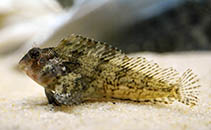
Rückenflossenstacheln (insgesamt) : 11 - 13; Rückenflossenweichstrahlen (insgesamt) : 13 - 16; Afterflossenstacheln: 2. Gill opening extending ventrally to opposite 7th-11th pectoral-fin ray; segmented dorsal-fin rays 13-16; segmented pelvic-fin rays 3; last dorsal-fin spine 8.5-15.5% SL; dorsal-fin spines robust and stiff; no elongate fleshy flap present posteriorly on lower lip; infraorbital bones 5-5; upper lip without free dorsal margin extending around snout; fleshy lobes of lower lip almost linear in lateral view and separated anterioventrally by a broad smooth area; bony interorbital width comparatively wider; dark spot usually present in spinous dorsal fin and centered on second spine; mandibular pores 4.
Body shape (shape guide): elongated; Cross section: oval.
Adults inhabit oyster reefs and rocky shores. Oviparous. Eggs are demersal and adhesive (Ref. 205), and are attached to the substrate via a filamentous, adhesive pad or pedestal (Ref. 94114). Larvae are planktonic, often found in shallow, coastal waters (Ref. 94114).
Lebenszyklus und Paarungsverhalten
Geschlechtsreife | Fortpflanzung | Ablaichen | Eier | Fruchtbarkeit | Larven
Oviparous, distinct pairing (Ref. 205).
Robins, C.R. and G.C. Ray, 1986. A field guide to Atlantic coast fishes of North America. Houghton Mifflin Company, Boston, U.S.A. 354 p. (Ref. 7251)
IUCN Rote Liste Status (Ref. 130435: Version 2025-2 (Global))
Bedrohung für Menschen
Harmless
Nutzung durch Menschen
Fischereien: nicht kommerziell
Tools
Zusatzinformationen
Download XML
Internet Quellen
Schätzungen auf der Grundlage von Modellen
Bevorzugte Temperatur (Ref.
123201): 12.5 - 26.1, mean 23.7 °C (based on 188 cells).
Phylogenetischer Diversitätsindex (Ref.
82804): PD
50 = 0.5000 [Uniqueness, from 0.5 = low to 2.0 = high].
Bayesian length-weight: a=0.00776 (0.00354 - 0.01702), b=3.00 (2.81 - 3.19), in cm total length, based on LWR estimates for this (Sub)family-body shape (Ref.
93245).
Trophische Ebene (Ref.
69278): 2.8 ±0.2 se; based on size and trophs of closest relatives
Widerstandsfähigkeit (Ref.
120179): hoch, Verdopplung der Population dauert weniger als 15 Monate. (Preliminary K or Fecundity.).
Anfälligkeit der Fischerei (Ref.
59153): Low vulnerability (10 of 100).
🛈
Nährstoffe (Ref.
124155): Calcium = 51.5 [16.8, 99.3] mg/100g; Iron = 0.286 [0.140, 0.560] mg/100g; Protein = 18.4 [17.1, 19.7] %; Omega3 = 0.233 [0.105, 0.504] g/100g; Selenium = 5.02 [1.83, 13.23] μg/100g; VitaminA = 86 [18, 428] μg/100g; Zinc = 1.1 [0.7, 1.8] mg/100g (wet weight);