>
Siluriformes (Catfishes) >
Clariidae (Airbreathing catfishes)
Etymology: Clarias: Greek, chlaros = lively, in reference to the ability of the fish to live for a long time out of water.
More on author: Linnaeus.
สิ่งแวดล้อม : สิ่งแวดล้อม / เขตภูมิอากาศ / ระดับความลึก / ระยะการกระจายสินค้า
นิเวศวิทยา
; น้ำจืด สัตว์น้ำหน้าดิน; สัตว์น้ำจืดที่มีการอพยพอย่างแท้จริงภายในแหล่งน้ำจืดเท่านั้น (Ref. 51243); ระดับความลึก 1 - ? m (Ref. 248). Tropical; 32°N - 5°N
Africa: lower and middle Nile; Chad system including the Logone and the Shari rivers; Niger and Benoue river systems; coastal rivers of Benin, Togo, Ghana and Côte d'Ivoire; Gambia and lower Senegal rivers; Volta system; relict populations occur in Mauritania and southern Algeria (Ref. 248). Also in the lower Cross in Nigeria (Ref. 81644). Trade restricted in FRG.
ขนาด / น้ำหนัก / อายุ
วัยเจริญพันธุ์: Lm ? range ? - ? cm
Max length : 100.0 cm TL เพศผู้/กระเทย; (Ref. 3799); น้ำหนักสูงสุดที่มีการรายงาน: 7.0 kg (Ref. 3799)
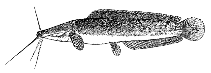
เงี่ยงครีบหลัง (รวม) : 0; ก้านครีบอ่อนที่หาง (รวม) : 60 - 82; ก้านครีบอ่อนที่ก้น: 42 - 61. Diagnosis: 16-50 gill rakers on first gill arch (much more reduced compared to Clarias gariepinus)(Ref. 57129, 81644), subject to geographical variations (Ref. 57129). Head oval-shaped to rectangular in dorsal outline; snout broadly rounded; eyes rather lateral in position and, together with relatively broad head, make for a relatively large interorbital distance; number of gill rakers on first branchial arch subject to much variation, 16-40, rarely exceeding 40; dorsal fin base situated close to occipital process; dorsal fin always terminates before caudal fin base, distance between both small; anal fin originates closer to caudal fin base than to tip of snout, nearly reaching caudal fin but never confluent; pelvic fin base slightly closer to tip of snout than to caudal fin base, reaching base of first anal fin rays; pectoral fin extend from operculum to base of first dorsal fin rays (Ref. 248). Pectoral spine slightly curved and robust (Ref. 248), serrated only on its outer side (Ref. 248, 81644), number of serrations increases with increasing standard length (Ref. 248). Lateral line appears as a small, white line running from posterior end of head to middle of caudal fin base (Ref. 248). Openings of secondary sensory canals (flank neuromasts) clearly marked, showing a regular pattern (Ref. 248, 81644).
Body shape (shape guide): elongated; Cross section: oval.
Facultative air-breathing (Ref. 126274); Very common in inundated areas. Bury themselves in the mud when the pools are drying up. Feed mainly on fish and mollusks; also crustaceans, diatoms, detritus and bottom organisms (Ref. 248). Omnivorous and reproduction takes place in the rainy saison (Ref. 78218). Max. size for West Africa and Lower Guinea: 650mm TL (Ref. 57129, 81644).
Breeding season varies among localities, apparently timed to the rainy season.
Teugels, G.G., 1986. A systematic revision of the African species of the genus Clarias (Pisces; Clariidae). Ann. Mus. R. Afr. Centr., Sci. Zool., 247:199 p. (Ref. 248)
สถานะบัญชีแดงของ IUCN (Ref. 130435: Version 2025-2 (Global))
ภัยคุกคามต่อมนุษย์
Harmless
การใช้ของมนุษย์
การประมง: มีการค้าเพียงเล็กน้อย; การเพาะเลี้ยงสัตว์น้ำ: การค้า
เครื่องมือ
รายงานพิเศษ
ดาวน์โหลด XML
แหล่งที่มาจากอินเตอร์เน็ต
การประมาณค่าตามแบบจำลอง
ดัชนีความหลากหลายทางวิวัฒนาการ (อ้างอิง
82804): PD
50 = 0.5000 [Uniqueness, from 0.5 = low to 2.0 = high].
Bayesian length-weight: a=0.00813 (0.00659 - 0.01003), b=2.97 (2.92 - 3.02), in cm total length, based on LWR estimates for this species (Ref.
93245).
ระดับชั้นอาหาร (อ้างอิง
69278): 3.4 ±0.51 se; based on food items.
ความสามารถในการกลับคืนสู่ปกติ (อ้างอิง
120179): ขนาดกลาง, เวลาต่ำสุดที่จะทำให้ประชากรเพิ่มขึ้นเป็น 2 เท่าใช้เวลา 1.4 - 4.4 ปี (Assuming tm=2-4; Fec < 10,000).
ความเสี่ยงต่อการตกปลา (Ref.
59153): High vulnerability (60 of 100).
🛈
สารอาหาร (Ref.
124155): Calcium = 18.9 [9.6, 92.2] mg/100g; Iron = 1.21 [0.68, 2.07] mg/100g; Protein = 16.9 [15.9, 18.0] %; Omega3 = 0.207 [0.067, 0.587] g/100g; Selenium = 151 [51, 382] μg/100g; VitaminA = 24.3 [8.1, 69.9] μg/100g; Zinc = 0.721 [0.509, 1.023] mg/100g (wet weight);