>
Blenniiformes (Blennies) >
Labrisomidae (Labrisomids)
Etymology: Paraclinus: Greek, para = the side of + Greek, klinein, kline = sloping and bed, due to the four apophyses of sphenoid bone (Ref. 45335).
More on authors: Evermann & Marsh.
Lingkungan: lingkungan / zona iklim / kisaran kedalaman / jangkauan distribusi
Ekologi
laut berasosiasi dengan karang. Tropical
Western Atlantic: southern Florida, USA and the Bahamas to the Greater Antilles and Honduras.
Ukuran / Berat / umur
Kematangan: Lm ? range ? - ? cm
Max length : 3.0 cm TL jantan/; (Ref. 7251)
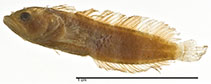
Duri dubur: 2. Common amongst Labrisomids: small, often elongate fishes; largest species about 20 cm standard length, most under 10 cm standard length. Head usually with cirri or fleshy flaps on anterior nostrils, eyes, and laterally on nape; gill membranes continuous with each other across posteroventral surface of head. Each jaw with an outer row of relatively large, canine-like or incisor-like teeth, often with patches of smaller teeth behind; teeth usually also present on vomer and often on palatines (roof of mouth). Dorsal and anal fins long, frequently highest anteriorly; dorsal-fin spines often flexible, outnumbering segmented dorsal-fin soft rays; 2 usually flexible spines in anal fin; pelvic fins inserted anterior to pectoral-fin bases, with 1 spine not visible externally; all fin rays, including those of caudal, unbranched (simple). Lateral-line tubes or canals varying from complete (extending entire length of body) to present only on anterior portion of body (absent in 1 species). Cycloid (smooth to touch) scales present at least posteriorly on body. Body coloration: varying from drab to brilliant hues; usually with irregular vertical bands, spots, or marbled pattern. Species distinguished by: pectoral-fin soft rays usually 12; no scales on pectoral-fin base; pelvic fin with 1 spine and 2 soft rays; last dorsal-fin element spinous; nuchal cirrus present on both sides of nape; no median fleshy barbel on chin; dorsal-fin elements consisting either of spines only or spines and 1 segmented ray (Ref.52855).
Body shape (shape guide): elongated.
Occurs in pockets of coral rubble on reefs or in tide pools.
Siklus hidup dan perilaku kawin
Kematangan | Reproduksi, perkembang biakan | Pemijahan | telur-telur | Fekunditas | Larva
Robins, C.R. and G.C. Ray, 1986. A field guide to Atlantic coast fishes of North America. Houghton Mifflin Company, Boston, U.S.A. 354 p. (Ref. 7251)
Status IUCN Red List (Ref. 130435: Version 2025-2 (Global))
ancaman kepada manusia
Harmless
penggunaan manusia
Alat, peralatan
laporan khas
muat turun XML
Sumber internet
Estimasi berdasarkan model
Indeks keanekaragaman filogenetik (Acuan
82804): PD
50 = 0.5000 [Uniqueness, from 0.5 = low to 2.0 = high].
Bayesian length-weight: a=0.00525 (0.00218 - 0.01265), b=3.08 (2.86 - 3.30), in cm total length, based on LWR estimates for this (Sub)family-body shape (Ref.
93245).
Tingkat Trofik (Acuan
69278): 3.2 ±0.4 se; based on size and trophs of closest relatives
Kerentanan Penangkapan Ikan (Ref.
59153): Low vulnerability (10 of 100).
🛈